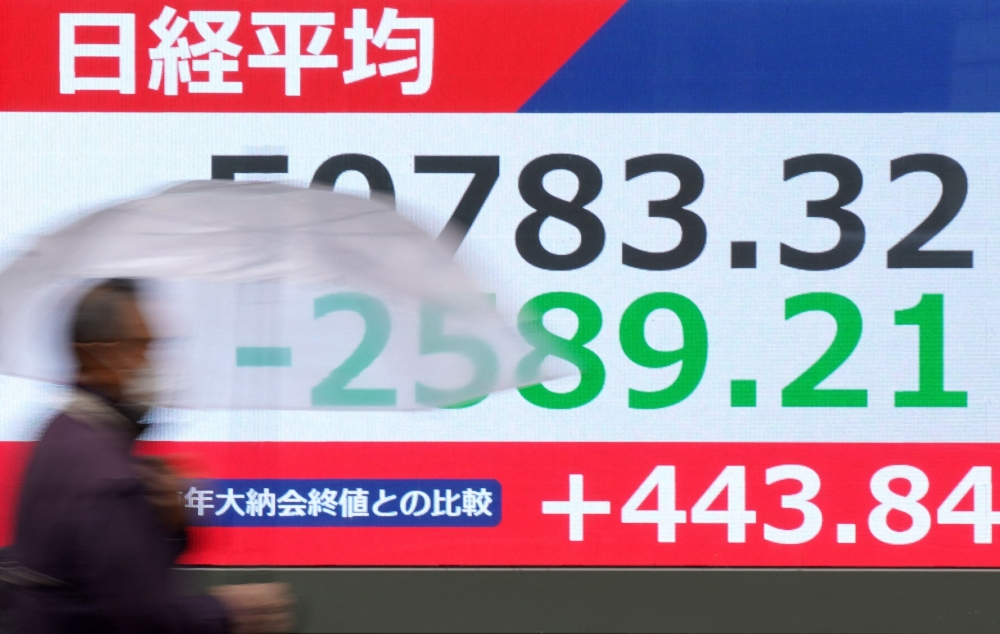
Asian stock markets slipped on Thursday as a recent relief rally lost momentum, while oil prices surged amid growing concerns over the ongoing confl
Investors across the region remained cautious as geopolitical developments continued to unfold rapidly. Market sentiment has been heavily influenced by uncertainty surrounding the conflict involving Iran and Western allies, which has already disrupted key global shipping routes and energy flows.

Major regional indices recorded notable declines during trading. Japan’s Nikkei index reversed earlier gains to fall about 0.7 per cent, while South Korean stocks dropped 2.7 per cent and Hong Kong’s Hang Seng index slid 1.7 per cent. Meanwhile, the MSCI Asia-Pacific index excluding Japan fell more than 1 per cent, putting it on track for its steepest monthly drop since October 2022.
The sudden shift in investor sentiment came after weeks of escalating tensions in the Middle East, which have rattled global markets. The conflict, triggered by military strikes earlier this year, has threatened the stability of the Strait of Hormuz, one of the world’s most critical oil shipping routes through which roughly one-fifth of global oil and liquefied natural gas supplies pass.
As concerns about supply disruptions intensified, oil prices surged significantly. Brent crude futures climbed above US$104 per barrel, marking a dramatic increase and putting the commodity on track for a monthly jump of more than 40 per cent. The sharp rise in energy prices has raised fears that global inflation could accelerate once again.
Financial analysts noted that the earlier optimism in markets was fading as traders reassessed the long-term economic implications of higher energy costs and prolonged geopolitical instability.
Charu Chanana, chief investment strategist at Saxo, said investors were beginning to realise that temporary hopes for peace may not be enough to stabilise markets in the short term. She noted that even if diplomatic talks eventually succeed, the inflationary pressures caused by soaring oil prices may continue to affect global economic policy.
Currency markets also reflected the cautious mood among investors. The US dollar remained near recent highs, reinforcing its role as a traditional safe-haven asset during times of geopolitical uncertainty. The stronger dollar has further complicated the outlook for emerging markets, which often face additional financial pressure when the greenback appreciates.
At the same time, central banks around the world are closely monitoring developments. Rising oil prices could push inflation higher, potentially forcing policymakers to maintain tighter monetary policies for longer. Some market participants have already begun to scale back expectations for interest rate cuts in the United States this year.
European markets were also expected to open lower, reflecting the cautious mood spreading across global financial centres. US stock futures similarly pointed to a weaker start on Wall Street as investors weighed the broader implications of the geopolitical crisis.
Despite the volatility, analysts say the direction of global markets in the coming weeks will largely depend on whether diplomatic efforts succeed in easing tensions in the Middle East. Even small signs of progress toward a ceasefire could calm investor nerves, while further escalation could trigger additional turbulence in both energy and financial markets.
For now, traders remain highly sensitive to every new development in the region, underscoring how closely global economic stability is tied to geopolitical events and the security of critical energy supply routes.