KUALA LUMPUR, JULY 2026 – Global economic growth could gradually approach zero over the next 100 years as trade restrictions, geopolitical competition and supply-chain disruptions continue to reshape the world economy, according to Malaysian economic adviser Nurhisham Hussein.
Nurhisham, who serves as Economic Adviser at the Prime Minister’s Office, said the long-term risk should not be dismissed simply because its full impact may only be felt by future generations. He stressed that the issue concerns not only the economic future of individual countries but also the wider prosperity of humanity.

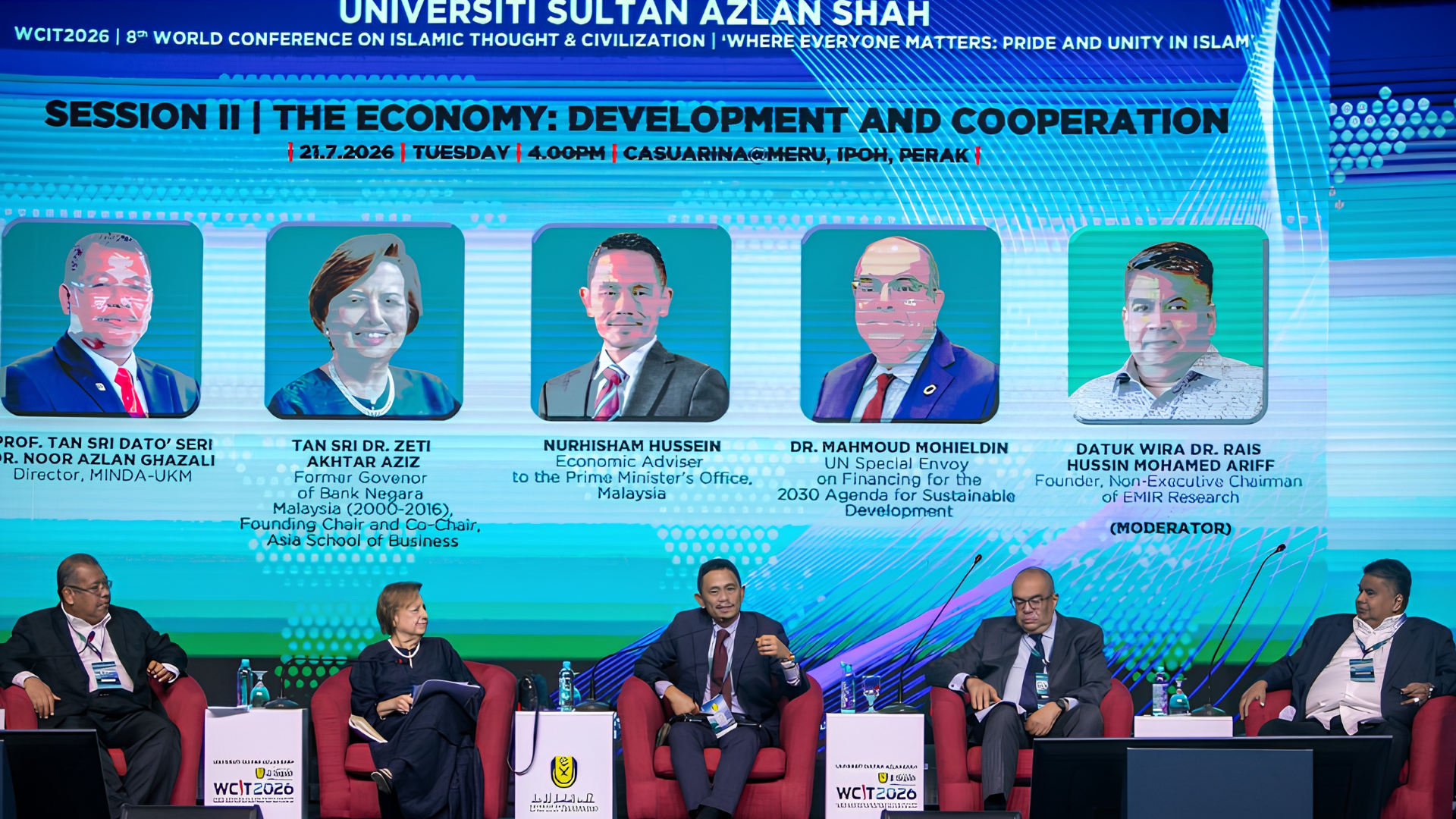
He made the remarks during a panel session titled The Economy: Development and Cooperation at the eighth World Conference on Islamic Thought and Civilisation in Ipoh. The conference was held under the theme Everyone Matters: Pride and Unity in Islam.
According to Nurhisham, the changing global environment requires countries, including Malaysia, to integrate national security considerations into economic policymaking. Such an approach could strengthen resilience against external shocks, particularly during periods of intensified geopolitical rivalry and uncertainty in international trade.
Malaysia benefits from its strategic geographical position along the Strait of Malacca and from having a relatively diversified economy. However, Nurhisham said the country remains highly dependent on overseas supply chains for several critical raw materials, energy resources and food-production inputs.
He highlighted Malaysia’s dependence on a single external source for almost its entire potash supply, while approximately 60 per cent of the country’s coal requirements are imported. Although Malaysia has achieved self-sufficiency in chicken production, the domestic poultry industry continues to rely on animal feed imported from Brazil and Argentina.
These dependencies could leave the economy exposed when conflicts, export restrictions, transport interruptions or political disputes disrupt established supply routes. Strengthening food security, energy security and industrial independence will therefore become increasingly important for Malaysia over the next two decades.
Nurhisham acknowledged that incorporating economic-security considerations into a free-trade system would involve additional costs. Diversifying suppliers, maintaining larger reserves and developing domestic production capabilities could improve resilience, but such measures may also reduce efficiency and raise operating expenses.
Those higher costs could eventually be passed on to consumers through more expensive products and services. As countries place greater emphasis on protecting strategic industries and essential supplies, the resulting trade-offs could contribute to slower economic growth over the long term.
The warning reflects wider concerns that the global economy is becoming increasingly fragmented as governments prioritise national security, strategic industries and domestic supply chains. Greater protectionism could limit international trade, weaken competition and reduce the exchange of technology, investment and knowledge between countries.
Former Bank Negara Malaysia governor Zeti Akhtar Aziz, who also participated in the panel, said Islamic finance could play a larger role in supporting more resilient economic growth. She noted that Islamic financial transactions are linked to real economic activities, making the system potentially less vulnerable to disruptions in financial markets.
Zeti, who is the founding chair and co-chair of the Asia School of Business, said profit-sharing structures, transparency and information disclosure are among the principles that could strengthen financial intermediation during periods of uncertainty.
The discussion highlighted the need for Malaysia to balance the benefits of open trade with stronger safeguards for essential supplies and strategic industries. Building resilience without creating excessive costs will remain a central economic-policy challenge as global geopolitical competition intensifies.