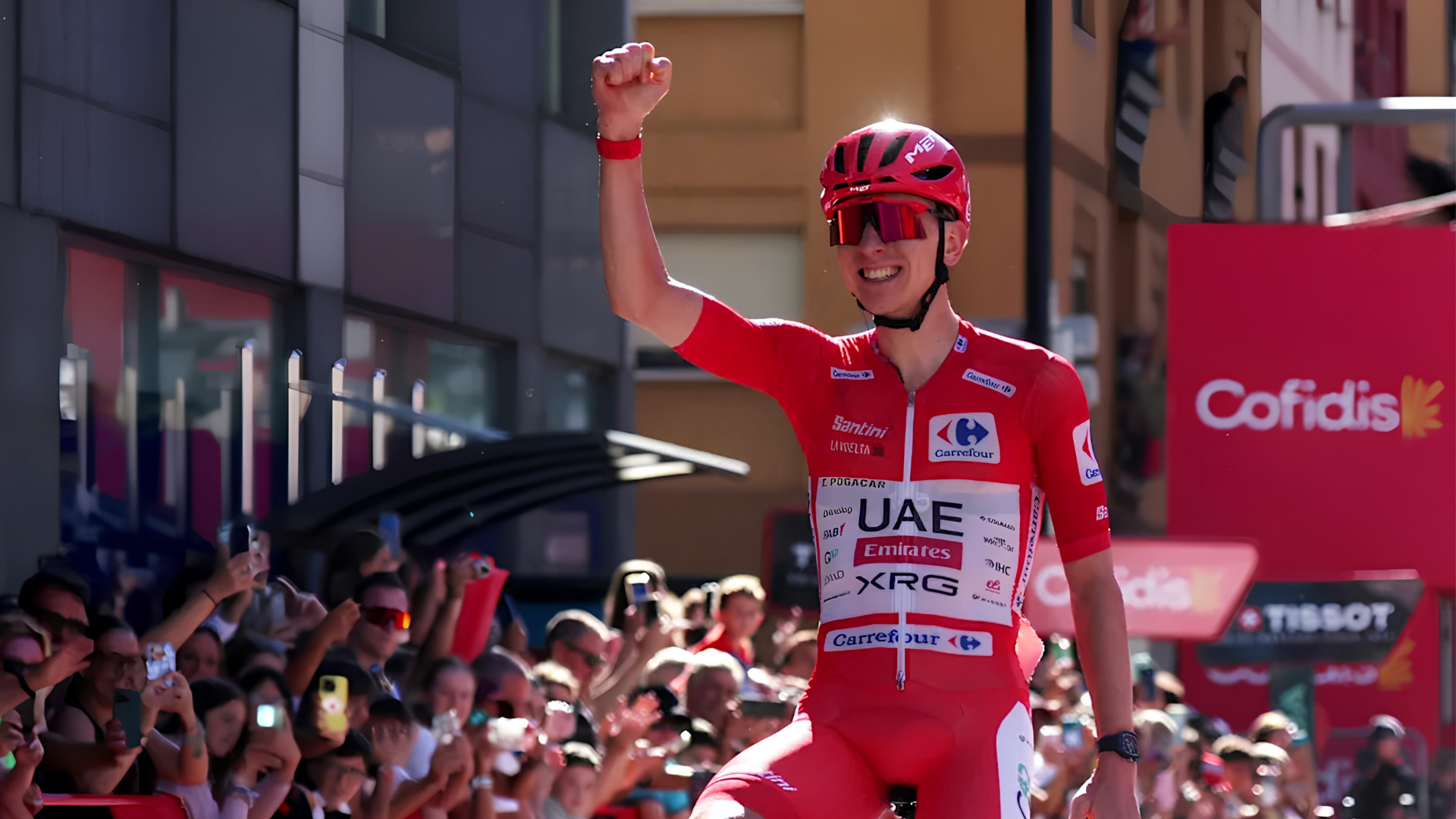
KUALA LUMPUR, AUGUST 2026 — Tadej Pogačar produced one of the most dominant performances of the opening week of the 2026 Vuelta a España, completing a remarkable solo raid to win the 104.8-kilometre fourth stage around Andorra la Vella.
The Slovenian world champion crossed the finish line alone in 2 hours, 40 minutes and 35 seconds, finishing 2:39 ahead of 20-year-old Belgian Jarno Widar, while Austria’s Félix Gall took third place.

The decisive moment arrived almost exactly halfway through the brutally mountainous stage.
As the race reached the Collada de Beixalis, a first-category climb measuring 6.5km at an average gradient of 8.5 per cent, Pogačar accelerated with approximately 50 kilometres remaining.
Gall initially attempted to follow the UAE Team Emirates-XRG leader, but he was quickly distanced. Within only a few kilometres, Pogačar had already established an advantage of around one minute over the chasing group.
Rather than slowing down and waiting for support, the red jersey continued alone.
His move eventually developed into his longest solo Grand Tour stage victory, according to Cyclingnews.
Stage 4 was short at just 104.8km, but packed more than 2,800 metres of climbing and offered virtually no respite to the peloton.
The route began with the first-category Port d’Envalira, a 23.3km climb averaging 5.1 per cent. Riders then faced the Collada de Beixalis, followed by the Col d’Ordino, which measured 9.9km at seven per cent, before the final Category 3 ascent of La Comella, 3.9km long at 5.9 per cent.
The intensity dramatically reduced the main group, with several general-classification hopefuls isolated or forced to chase as teams attempted to put pressure on Pogačar.
Decathlon CMA CGM played a major role in making the race difficult, setting a demanding tempo for Gall.
Their pressure helped bring the early breakaway back with around 67km remaining, before the race reached the Beixalis climb.
But the aggressive strategy ultimately provided Pogačar with the platform to attack.
The Slovenian explained after the finish that he did not originally need to attack from so far out, but chose to make his move because he did not want to become isolated against several GC rivals.
Pogačar said the pace had already been extremely high and, once a gap opened, he committed fully to riding alone to the finish.
Behind Pogačar, the battle quickly became one for second place and the remaining podium positions.
Riders including Primož Roglič, Enric Mas, Sepp Kuss, Richard Carapaz, Oscar Onley, Mattias Skjelmose and Gall attempted to organise themselves, but repeated attacks and tactical hesitation prevented the chase from significantly reducing Pogačar’s advantage.
At one stage on the Col d’Ordino, Roglič attacked from the chasing group and quickly bridged across to Gall and Onley.
Kuss and Mas also responded, while Carapaz and Skjelmose remained among the riders contesting the positions behind the runaway race leader.
None, however, came close to catching Pogačar.
Behind the dominant stage winner, young Belgian Jarno Widar delivered one of the most impressive performances of his developing career.
The Lotto-Intermarché rider won the sprint from the chase group to finish second, 2:39 behind Pogačar, beating Gall to the line for the runner-up position.
Cyclingnews noted that the result came on only the fourth Grand Tour stage of Widar’s career, making his performance against established GC contenders particularly significant.
Gall finished third, followed by Onley, Kuss, Mas and Roglič, while Carapaz crossed the line 2:57 down and Skjelmose lost 3:17.
Stage 4 Top Finishers
The leading results from Stage 4 were:
- Tadej Pogačar (UAE Team Emirates-XRG) — 2:40:35
- Jarno Widar (Lotto-Intermarché) — +2:39
- Félix Gall (Decathlon CMA CGM)
- Oscar Onley (Netcompany INEOS)
- Sepp Kuss (Visma-Lease a Bike)
- Enric Mas (Movistar)
- Primož Roglič (Red Bull-Bora-Hansgrohe)
- Richard Carapaz (EF Education-EasyPost) — +2:57
- Mattias Skjelmose (Lidl-Trek) — +3:17.
The victory dramatically strengthened Pogačar’s position in the overall standings.
After four stages, he leads the Vuelta with a total time of 7:38:59, while four-time Vuelta champion Roglič sits second at 3:21.
Mas is third at 3:32, followed by Kuss at 3:44 and Onley at 3:45. Carapaz is sixth at 3:50, Gall seventh at 3:57 and Skjelmose eighth at 4:06.
The size of Pogačar’s advantage is particularly striking considering the race still has most of its three-week journey remaining.
Pogačar’s dominant opening to the Vuelta has also put him in control of several classifications.
After Stage 4, he remained the red jersey leader, while also leading the points competition with 82 points and the mountains classification with 23 points.
Onley moved into the best young rider’s white jersey, holding a 21-second advantage over Widar in that competition.
The official Vuelta confirmed Pogačar as the Stage 4 winner and leader of the race following the Andorra showdown.
The victory carried additional significance for Pogačar because Andorra played an important role in the early stages of his career.
It was there during the 2019 Vuelta a España that the Slovenian secured his first Grand Tour stage victory and announced himself as one of cycling’s emerging stars.
Seven years later, he returned as world champion and one of the sport’s dominant figures, producing another memorable victory on the same mountainous roads.
Stage 4 also marked a return to normal racing after the extraordinary events of the previous day.
Stage 3 toward Font-Romeu was wiped from the record after a severe hailstorm struck the route with approximately 15km remaining, forcing riders to seek shelter and race organisers to cancel the remainder of the stage.
Better conditions greeted riders in Andorra, but the terrain created an entirely different challenge — and Pogačar took full advantage.
With 17 stages still remaining after the Andorra test, the fight for the overall title is far from mathematically decided.
However, Pogačar’s performance has already transformed the shape of the race.
A 50km solo attack, a stage-winning margin approaching three minutes and a general-classification lead exceeding three minutes have given the Slovenian a significant buffer over his principal rivals.
Pogačar acknowledged that the advantage allows him to approach the coming stages with greater confidence, but stressed that UAE Team Emirates-XRG will continue taking the race one day at a time.
For Roglič, Mas, Kuss, Onley, Carapaz and the rest of the GC contenders, Stage 4 delivered an unmistakable warning: Pogačar has arrived at the 2026 Vuelta ready to dominate.