WASHINGTON, El Sky News — Following the dramatic U.S. operation against Venezuela that led to the arrest of President Nicolás Maduro, the foreign policy direction of President Donald J. Trump has come under intense global scrutiny. Analysts warn that the move signals a more aggressive and unilateral U.S. posture, raising concerns about which countries or regions could be next in Washington’s crosshairs.
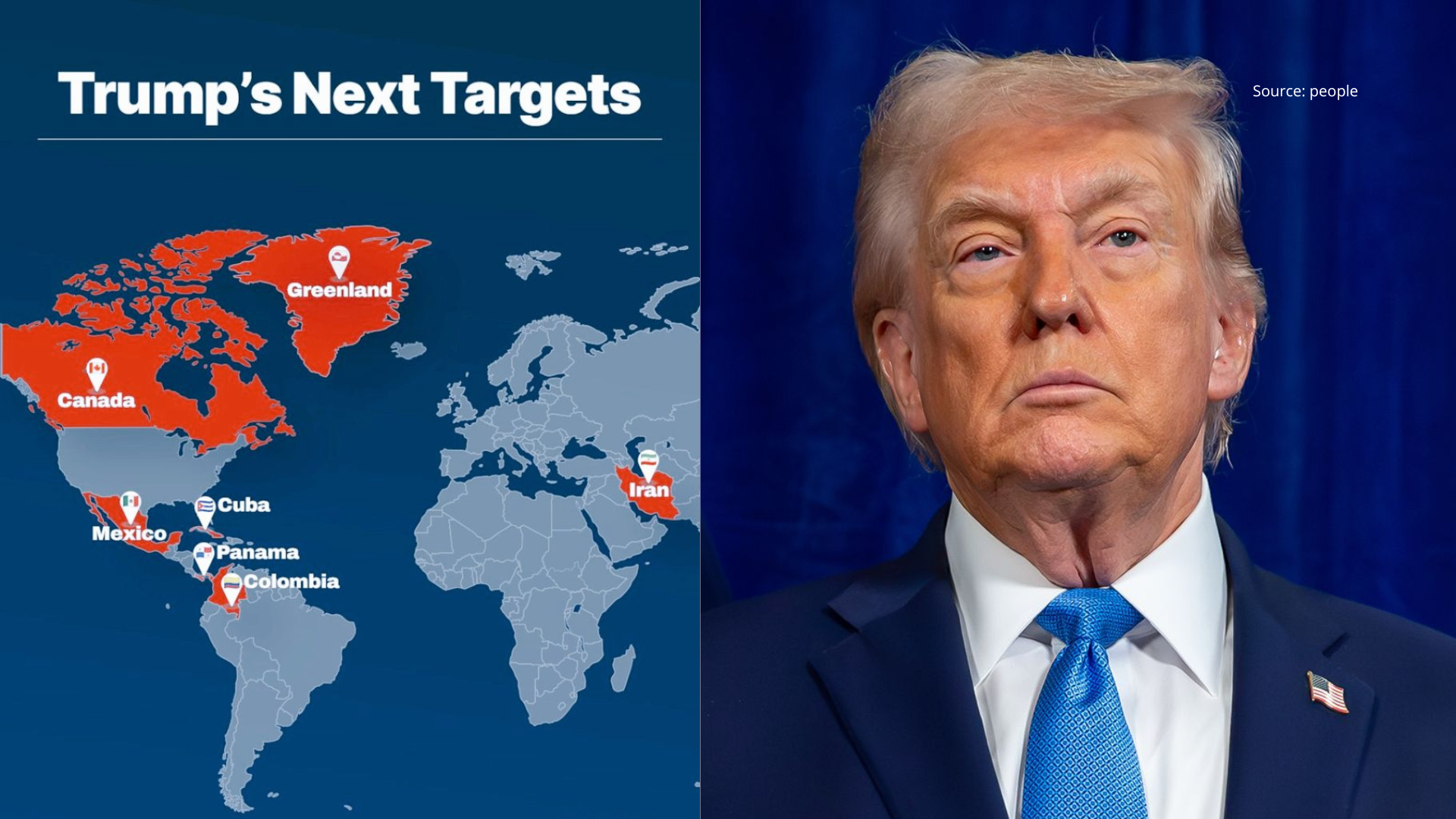
Trump’s post-Venezuela strategy is widely viewed as a modern reinterpretation of the Monroe Doctrine, aimed at reasserting U.S. dominance in the Western Hemisphere while extending pressure to other strategically significant regions. Below are five countries and territories that observers say are now emerging as potential targets of Trump’s foreign policy agenda.

1. Colombia — Rising Tensions and Talk of Intervention
Colombia has drawn particular attention after President Trump openly criticized Colombian President Gustavo Petro, accusing his government of failing to curb drug trafficking. Trump publicly suggested that military action in Colombia “might be a good idea,” a statement that triggered widespread protests and strong diplomatic backlash in Bogotá.
Although both leaders later agreed to pursue dialogue and de-escalation, analysts note that Colombia remains under close U.S. scrutiny due to its strategic location and long-standing role in regional security cooperation.
2. Cuba — Economic Pressure After the Fall of Venezuela
Cuba, a long-time ally of Venezuela, is facing renewed pressure following Washington’s increased control over Venezuelan oil flows. Trump has openly suggested that Cuba’s economy could collapse without Caracas’ support, signaling a strategy focused on economic strangulation rather than direct military action.
While no immediate military threat has been issued, Havana is widely seen as a key target in Trump’s broader effort to dismantle left-leaning governments in the Caribbean.
3. Greenland — Strategic Competition in the Arctic
Greenland, an autonomous territory of Denmark, has once again emerged in Trump’s rhetoric as a strategic asset critical to U.S. national security. Trump has argued that the United States “needs Greenland” to counter growing Russian and Chinese influence in the Arctic.
The remarks have angered Danish officials and raised concerns among NATO allies, as Greenland’s strategic importance continues to grow amid global competition over Arctic resources and military positioning.
4. Mexico — Cartels, Sovereignty, and Security Pressure
Mexico has also entered the spotlight, as Trump continues to link U.S. security concerns to Mexico’s struggle against powerful drug cartels. While the Mexican government has firmly rejected any suggestion of U.S. military involvement on its territory, Trump has used sharp rhetoric and diplomatic pressure to push for tougher enforcement.
Observers warn that such language risks undermining Mexican sovereignty and destabilizing an already sensitive bilateral relationship.
5. Iran — A Persistent Geopolitical Adversary
Iran remains a long-standing target of U.S. foreign policy, and Trump’s rhetoric has once again hardened following the Venezuela operation. The administration has warned Tehran against cracking down on domestic protests and expanding its influence in the Middle East.
Although no immediate military action has been announced, analysts believe Iran remains a potential flashpoint for escalation, particularly amid rising tensions in the region.
Global Implications of Trump’s Post-Venezuela Strategy
Foreign policy experts argue that Trump’s expanding list of targets reflects a shift toward power-driven diplomacy, blending military force, economic pressure, and aggressive rhetoric. The approach has sparked protests in several countries and renewed debates about U.S. interventionism and global stability.
Critics warn that such a strateg risks escalating conflicts and weakening international norms, while supporters argue it reinforces U.S. strength and deterrence on the world stage.
After Venezuela, President Trump’s foreign policy appears poised to expand its reach. Colombia, Cuba, Greenland, Mexico, and Iran now stand at the center of global attention, each facing different forms of U.S. pressure. As tensions rise, the world watches closely to see whether Washington’s next moves will lead to diplomacy or further confrontation.
(Lunar)