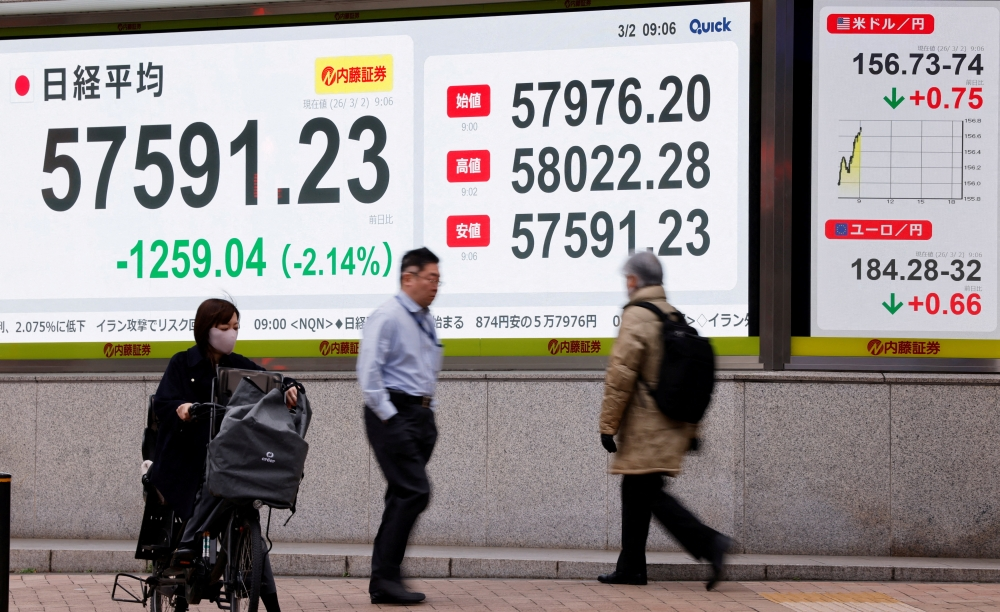
TOKYO, March 3 — The U.S. dollar strengthened further on Tuesday as geopolitical tensions in the Middle East intensified, driving investors into safe-haven assets and putting pressure on energy-importing currencies such as the euro and Japanese yen.
The escalation of the conflict — sparked by renewed air strikes and retaliation between the United States, Israel and Iran — has refocused global markets on the potential for prolonged instability in energy supply chains, particularly in the Strait of Hormuz, a critical shipping route for roughly one-fifth of the world’s crude oil.

As fears over supply disruptions heighten, the dollar has benefited from demand for non-risk assets. The ICE U.S. Dollar Index, which tracks the U.S. currency against a basket of major currencies, traded at 98.49, maintaining gains after a strong rise the previous session. The rally underscores the dollar’s traditional role as a refuge in times of geopolitical stress.
Against this backdrop, the euro and yen broadly lagged. The euro, weighed by Europe’s heavy dependence on imported energy, steadied only marginally after sliding more than 1 per cent earlier in trading. The Japanese yen, similarly challenged by Japan’s need to import energy, saw modest gains after a prior sharp drop, but remains under pressure as markets weigh monetary policy signals and inflation outlooks.
Japanese Finance Minister Satsuki Katayama hinted that authorities are prepared to intervene in the currency markets to support the yen if necessary, and investor attention is now on a forthcoming speech by Bank of Japan Governor Kazuo Ueda, which could provide clues about future interest-rate decisions amid the turmoil.
Rodrigo Catril, a currency strategist at National Australia Bank, noted that economies heavily reliant on imported energy — like those of Europe and Japan — are uniquely vulnerable in the current environment, as rising oil and gas costs intensify inflationary pressures and weaken their currencies.
In the foreign exchange markets, the euro inched up slightly to around US$1.1695, while the yen rose to approximately 157.2 per dollar after tumbling in the prior session. The British pound was little changed, trading near US$1.3407.
The ongoing conflict has already pushed global energy prices upwards. Brent crude oil — the international benchmark — has climbed sharply as shipping through the Strait of Hormuz becomes riskier, stoking fears of supply shortages and inflation acceleration. Several industry analysts now see prices potentially rising toward or above US$90-US$100 per barrel if disruptions persist.
With safe-haven demand rising, other assets like gold and the Swiss franc have also seen increased interest. According to recent market data, the Swiss franc reached its strongest levels in more than a decade, gaining ground against both the euro and the dollar as investors hedge geopolitical risk.
Central banks now confront difficult trade-offs. Higher energy prices and renewed inflation pressures could force policymakers in Europe and Japan to reconsider accommodative settings. Meanwhile, the U.S. Federal Reserve — already grappling with decelerating growth and inflation signals — must balance domestic economic conditions with the global impact of the turmoil.
The ripple effects extend beyond currency markets. Stock markets in Europe and Asia have shown increased volatility, with some major indices dipping amid mounting uncertainty, while safe-haven government bonds have drawn increased inflows.
Overall, the latest currency movements underscore how geopolitical risk — particularly involving the Middle East’s pivotal role in energy supplies — is once again reshaping global financial markets. Traders and policymakers alike are bracing for continued volatility as the conflict unfolds