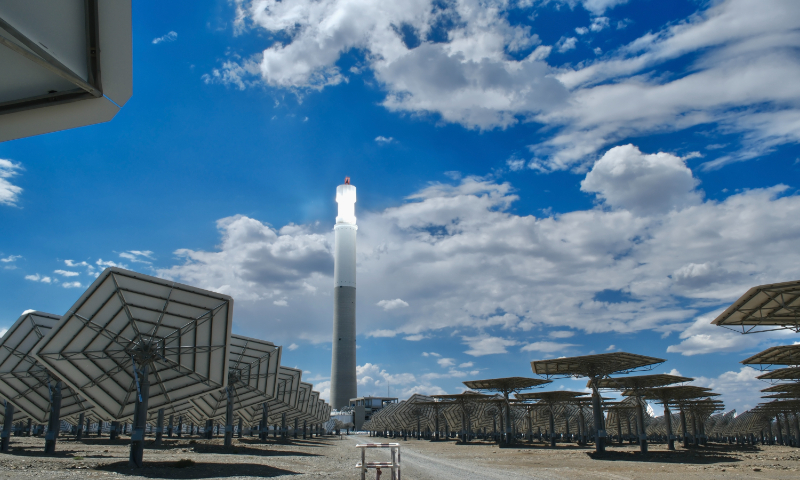
In the vast, barren expanse of the Gobi Desert—once defined by nothing but wind, sand, and cracked earth—a striking technological landscape now emerges. Thousands of massive mirrors reflect sunlight toward a towering central structure, forming one of China’s most ambitious renewable energy projects: the Hami solar thermal power plant.
At the heart of the facility are 14,500 reflective mirrors, carefully aligned to concentrate sunlight onto a central tower. This intense energy generates heat exceeding 560°C, which is used to melt a special nitrate salt mixture. The heated molten salt is then stored in insulated tanks, allowing the plant to continue generating electricity even after sunset.

“The stored energy ensures continuous power generation throughout the night, making solar thermal energy highly reliable,” said Liu Zenghui, Deputy General Manager of New Energy Technology Company, in a statement to Global Times
How It Works: Beyond Traditional Solar Panels
Unlike conventional photovoltaic (PV) systems that convert sunlight directly into electricity, solar thermal technology transforms sunlight into heat first. This heat is then used to produce steam, drive turbines, and generate electricity.
This approach provides a major advantage: stable and continuous power supply, rather than depending solely on sunlight availability during the day.
Innovation and Engineering Precision
The Hami plant, with a capacity of 50 megawatts, is one of China’s earliest large-scale solar thermal projects and the only one of its kind in Xinjiang. It was designed by the Northwest Electric Power Design Institute.
The system uses advanced engineering, including:
- Mirrors that continuously rotate to track the sun
- Precision alignment where even millimeter-level errors can reduce efficiency
- A cloud-based simulation system developed in Xi’an to replicate real-world operating conditions and enhance safety
Additionally, the mirrors are designed in a fixed pentagonal shape, optimizing land use while reducing material costs.
Energy Storage: Power Even at Night
One of the plant’s most impressive features is its thermal energy storage system. The molten salt can retain heat for up to 15 hours, enabling electricity generation throughout the night without additional fuel.
However, maintaining this system is highly complex. If the temperature drops below 220°C, the salt can solidify and block pipelines. As a result, every component—from storage tanks to pipelines—must be carefully engineered to withstand extreme desert conditions and temperature fluctuations.
China’s Bigger Energy Strategy
The Hami project is part of a larger push by China to accelerate its transition to clean energy. According to the National Energy Administration, the country’s total installed power capacity surpassed 3 billion kilowatts in 2024, with solar energy alone reaching 670 million kilowatts, marking significant year-on-year growth.
The plant also plays a key role in China’s “West-to-East Power Transmission” initiative, which delivers clean energy from resource-rich western regions to industrial hubs in the east.
With over 3,200 hours of sunlight per year, low population density, and harsh environmental conditions, Hami serves as an ideal testing ground for advanced renewable technologies—including solar thermal systems, wind power, and large-scale energy storage.
Conclusion
The Hami solar thermal power plant is more than just an energy project—it represents a shift toward reliable, scalable, and storable renewable energy.
In a world moving away from fossil fuels, China is not only embracing clean energy—but also redefining how it can be stored and delivered around the clock.