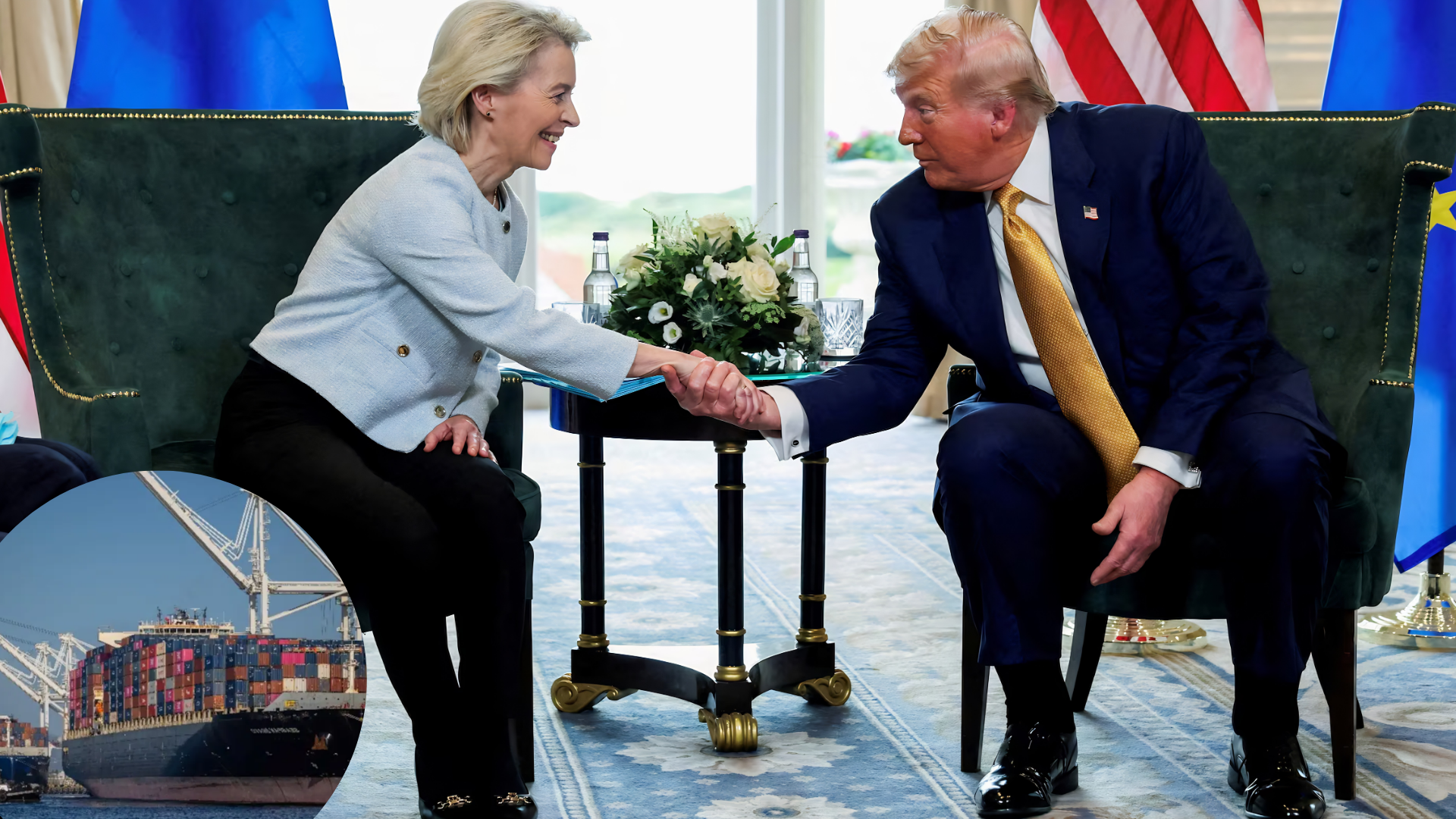
KUALA LUMPUR,MAY,2026 – The European Union has moved to speed up the start of its trade deal with the United States after reaching a provisional agreement on legislation to remove import duties on selected US goods.
The agreement marks a major step toward finalising the transatlantic trade pact that was reached with Washington in July last year. According to Bloomberg, the EU finalised the text of the long-delayed deal after months of negotiations, clearing a major hurdle before US President Donald Trump’s threatened deadline for higher tariffs.

Reuters reported that the provisional agreement will allow the EU to move forward with legislation removing import duties on US goods, fulfilling a key part of the trade deal made with the United States. The move is aimed at preventing Washington from increasing tariffs on European products.
Trump had set a July 4 deadline for the EU to implement the agreement. He previously warned that the United States could raise tariffs on European goods if Brussels failed to comply with the terms of the deal, including a possible increase in car import duties to 25%.
The original agreement included EU concessions to cut tariffs on US industrial goods and provide duty-free quotas for certain American farm and seafood products. In return, the United States allowed a 15% tariff on most EU goods under the agreed framework.
The latest development suggests Brussels is trying to avoid a renewed tariff clash with Washington. European officials have faced pressure to deliver on the deal quickly, especially after Trump accused the EU of moving too slowly in implementing its commitments.
The provisional text has received approval from both European Parliament and EU Council negotiators. A final vote in the European Parliament is expected in mid-June, giving the bloc a chance to complete the process before Trump’s July 4 deadline.
The legislation is also expected to include safeguards if the United States fails to uphold its commitments under the trade deal. EU lawmakers had pushed for stronger protective clauses, including delayed implementation and automatic expiry of concessions, while some EU governments favoured a more conciliatory approach to avoid worsening ties with Washington.
The deal comes at a sensitive time for transatlantic trade. The EU and US remain major trading partners, but tariff disputes have repeatedly strained the relationship, especially over cars, industrial goods, agriculture, steel and aluminium.
For the EU, the immediate priority is to prevent higher US tariffs from hitting European exporters. A tariff hike on cars and trucks would be especially painful for major automotive economies such as Germany, France, Italy, Spain and Sweden.
For the United States, the agreement gives Trump a political win by pressuring Brussels to cut barriers on American goods. The deal also reinforces his administration’s use of tariffs as leverage in trade negotiations.
The EU’s decision to accelerate implementation reflects a practical calculation. While some lawmakers wanted stronger protections before granting concessions, delaying the deal further could have exposed European businesses to immediate tariff pressure from Washington.
The trade issue also comes as Europe faces broader economic uncertainty, including high energy costs, inflation concerns and geopolitical tensions linked to the Middle East. Avoiding a new trade fight with the United States may help reduce pressure on European exporters and financial markets.
However, the agreement does not fully resolve all US-EU trade disputes. Reuters reported that future negotiations are still expected, particularly on sensitive areas such as steel and aluminium.
The final vote in the European Parliament will now be closely watched. If approved, the EU will be able to move forward with the duty cuts before the US deadline, reducing the risk of an immediate tariff escalation.
Overall, the EU’s latest move shows that Brussels is trying to stabilise trade relations with Washington while protecting European industries from a new round of tariff pressure. The provisional agreement does not remove all tensions, but it brings both sides closer to implementing a deal that could shape transatlantic trade in the months ahead.