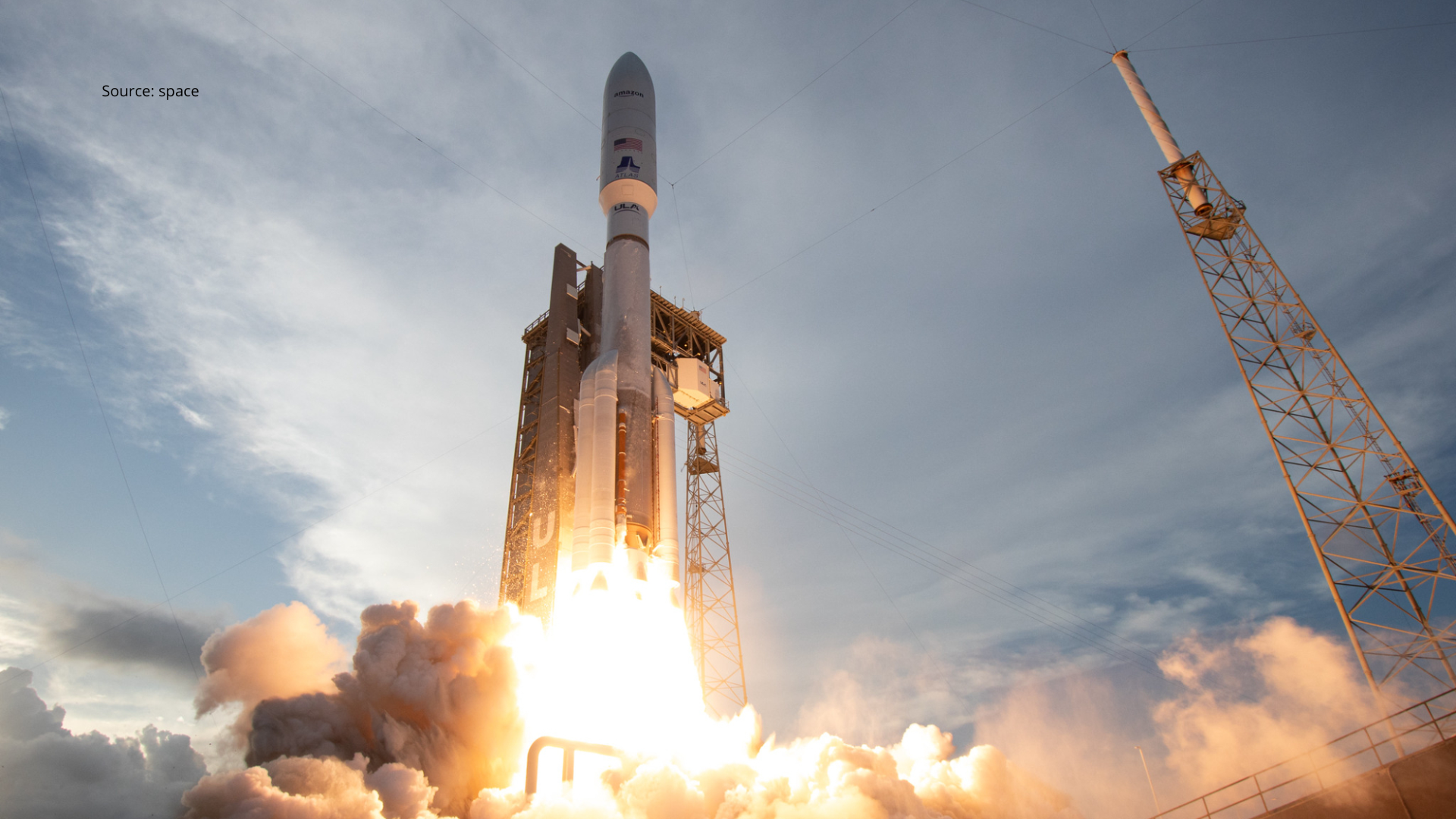
Florida, El Sky News — In a major step toward expanding global internet coverage, United Launch Alliance (ULA) successfully launched 27 Amazon Low Earth Orbit (LEO) satellites aboard its Atlas V rocket from Cape Canaveral Space Launch Complex, Florida. The mission marks a significant milestone in Amazon’s ongoing efforts to develop a worldwide broadband network aimed at increasing internet access to underserved regions.
Launch Overview

The Atlas V rocket lifted off at 09:45 EST under clear weather conditions, following meticulous preparations by ULA engineers and mission control teams. The payload Amazon’s constellation of LEO satellites is designed to operate at altitudes between 500 and 1,200 kilometers, providing low-latency, high-speed internet services globally.
According to Amazon’s Project Kuiper team, the newly deployed satellites will enhance network redundancy, improve bandwidth for remote areas, and bolster connectivity for educational, commercial, and emergency response applications. The company aims to eventually deploy 3,236 LEO satellites as part of the Project Kuiper constellation, with this launch representing one of the largest single batches to date.
Technical Details
- Rocket: ULA Atlas V 401 configuration
- Payload: 27 Amazon LEO satellites
- Orbit: Low Earth Orbit, polar trajectory to ensure near-global coverage
- Objective: Expand internet access, increase network reliability, and support disaster management communications
The launch sequence involved a precise ignition of the Centaur upper stage, successfully deploying all 27 satellites into their designated orbital slots. Each satellite is equipped with advanced Ka-band and Ku-band transponders, solar arrays, and onboard propulsion systems to maintain orbital positioning.
Significance for Global Connectivity
Experts highlight that LEO satellite constellations like Amazon Kuiper, SpaceX Starlink, and OneWeb are transforming global telecommunications. By orbiting closer to Earth than traditional geostationary satellites, LEO satellites reduce latency drastically, enabling smoother video streaming, online gaming, telemedicine, and other internet-based applications in regions previously underserved by terrestrial networks.
Amazon CEO Andy Jassy stated,
“Today’s launch brings us closer to our mission of connecting every corner of the world with fast, reliable internet. Expanding global connectivity is essential for economic opportunity, education, and bridging the digital divide.”
Future Plans
Amazon Project Kuiper plans several more launches before mid-2026, aiming to complete its initial constellation and begin commercial service testing. ULA has also confirmed continued collaboration on upcoming Atlas V and Vulcan Centaur launches, emphasizing mission safety, reliability, and adherence to international space regulations.
Global Impact
The launch reflects a growing trend of commercial space ventures playing a critical role in global infrastructure. With millions still lacking reliable internet access, initiatives like Project Kuiper have the potential to transform education, commerce, and communication worldwide, particularly in remote or developing regions.
(Lunar)