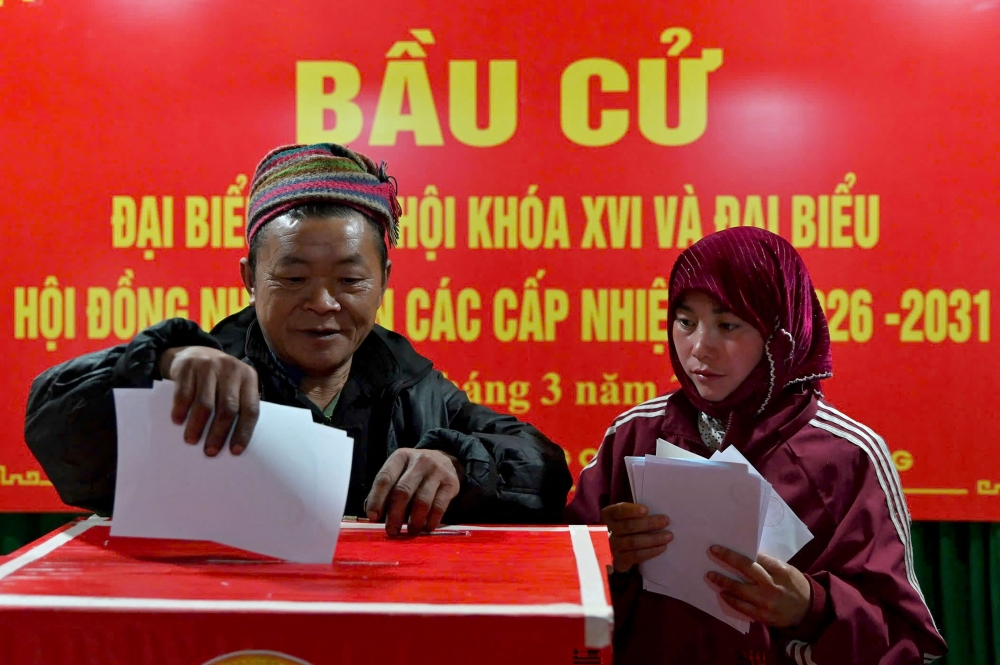
HANOI — Millions of voters across Vietnam went to the polls as the country held its latest parliamentary election, with the ruling Communist Party of Vietnam fielding the overwhelming majority of candidates.
The vote will determine the composition of the National Assembly of Vietnam, the country’s highest legislative body, which consists of 500 members. Tens of millions of eligible voters participated in the nationwide ballot, which is held every five years as part of Vietnam’s political system.

According to official data, nearly 93 per cent of the candidates contesting the election are members of the Communist Party, reflecting the party’s continued dominance in the Southeast Asian nation’s one-party political structure.
Only a small proportion of candidates are independent or non-party nominees, with their share declining compared with previous elections. Reports indicate that independent candidates account for roughly 7.5 per cent of the total candidate pool, down from about 8.5 per cent in the previous parliamentary vote five years ago.
The election involves a list of around 864 approved candidates competing for 500 parliamentary seats, and voters are also choosing representatives for local councils during the same ballot.
While the National Assembly functions as Vietnam’s main legislative body, political analysts say its role is largely to formalise policies and leadership decisions made by the Communist Party leadership. Major government appointments are typically determined internally within the party before being formally approved by parliament following elections.
The parliamentary election comes shortly after the Communist Party held its national congress earlier this year, during which key leadership positions and national policy directions for the coming years were determined.
Observers note that the vote is an important mechanism in Vietnam’s political system, allowing citizens to participate in selecting representatives while maintaining the country’s one-party governance structure.
Historically, voter turnout in Vietnamese elections has been extremely high, often exceeding 90 per cent, as polling stations open across cities, rural areas, and industrial regions throughout the country.
The newly elected National Assembly is expected to convene in the coming weeks to formally approve key state leadership positions and begin deliberations on legislative priorities for the next five-year term.
Among the issues expected to dominate the new parliamentary agenda are economic development, administrative reforms, infrastructure expansion, and efforts to strengthen Vietnam’s role as a regional manufacturing hub amid shifting global supply chains.
Over the past decade, Vietnam’s economy has experienced strong growth, attracting foreign investment in sectors such as electronics, textiles, and high-technology manufacturing. Policymakers hope the next parliamentary term will continue to support economic expansion while maintaining political stability.
Analysts say the outcome of the election is unlikely to dramatically alter Vietnam’s political landscape, as the Communist Party has ruled the country for decades and currently holds an overwhelming majority of parliamentary seats.
Nevertheless, the election remains an important milestone in Vietnam’s governance cycle, reaffirming the political leadership’s authority while setting the