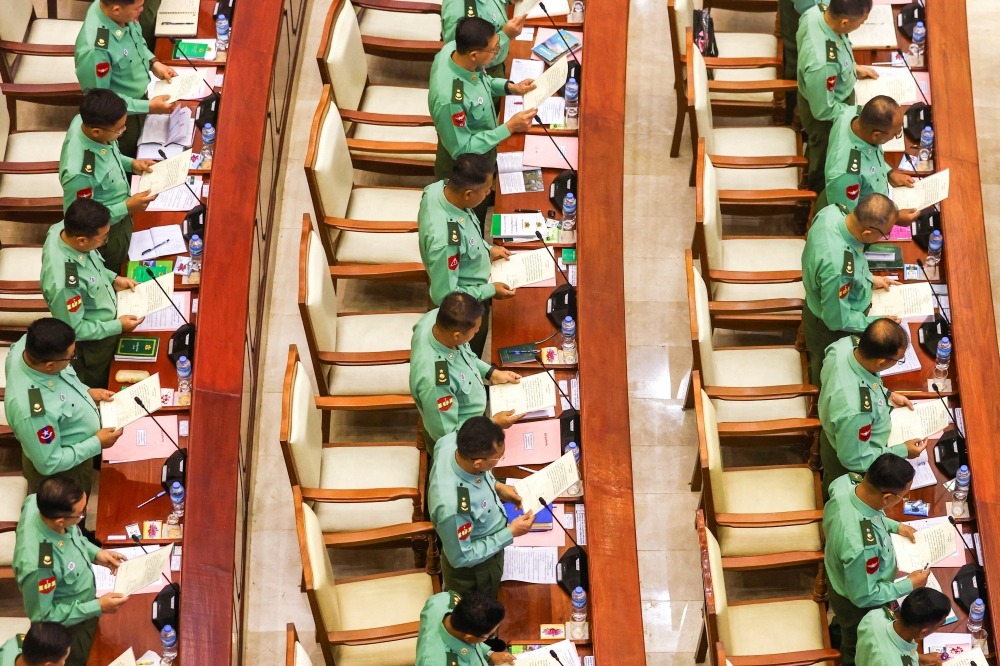
NAYPYIDAW, April 2 — Myanmar’s parliament will hold a bicameral vote on Friday to elect the country’s next president, in a closely watched political process taking place under significant international scrutiny.
The announcement was made by parliamentary speaker Aung Lin Dwe, who confirmed that lawmakers from both houses of parliament will convene in a joint session to select the president from among three nominated vice-presidential candidates.

Among the leading contenders is Min Aung Hlaing, the former military commander who led the 2021 coup that ousted the democratically elected government of Aung San Suu Kyi.
Min Aung Hlaing, 69, recently stepped down from his role as commander-in-chief of Myanmar’s armed forces after more than 15 years leading the military, a move widely interpreted as part of his transition into formal civilian leadership.
The presidential selection process in Myanmar involves three groups within parliament — the lower house, the upper house, and a bloc representing the military — each nominating a vice-presidential candidate. Lawmakers from both chambers then vote collectively, and the candidate receiving the highest number of votes becomes president.
The upcoming vote comes after a controversial general election held between December 2025 and January 2026, which was won by the military-backed Union Solidarity and Development Party (USDP). The election faced widespread criticism from the United Nations and several Western governments, many of which questioned its legitimacy and fairness.
Myanmar has remained politically unstable since the 2021 coup, which triggered widespread protests and later escalated into a prolonged civil conflict involving pro-democracy groups and ethnic armed organisations. The violence and political crisis have displaced millions of people and severely damaged the country’s economy.
Analysts say the presidential vote is likely to reinforce the military’s influence over Myanmar’s political system, even as the government attempts to project a return to civilian governance. Observers note that the military continues to hold significant parliamentary representation and maintains substantial control over key state institutions.
Despite the expected political transition, international observers remain cautious about the future direction of Myanmar’s leadership and the potential for meaningful democratic reforms. Human rights organisations and several governments have called for the release of political prisoners and the restoration of democratic institutions before recognising any new administration formed under the current political framework.
The vote is scheduled to take place at 10:00 a.m. local time in Naypyidaw, where lawmakers from both parliamentary chambers will gather to determine the country’s next head of state.
The outcome of the vote is expected to shape Myanmar’s political landscape in the coming years as the country continues to grapple with internal conflict, international pressure, and economic challenges.