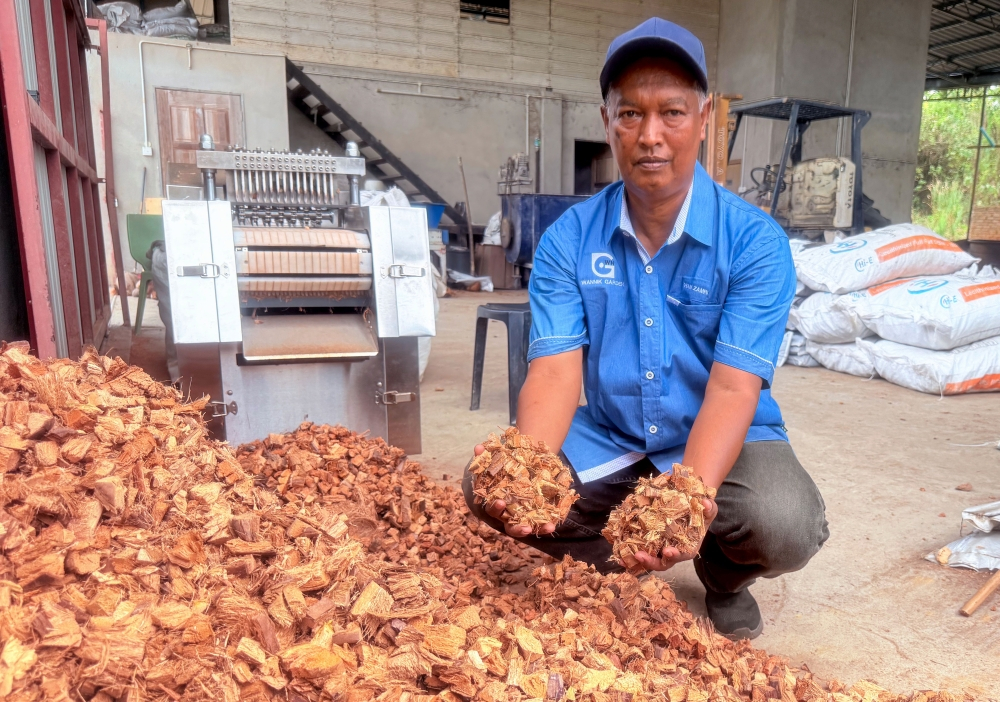
KUALA LUMPUR, May, 2026 — What many people see as agricultural waste, one retiree in Kelantan sees as an opportunity for income and sustainability.
A retiree from Kampung Batu Hitam, Tanah Merah, has successfully transformed discarded coconut husks into profitable planting products, turning what was once burned or thrown away into high-demand agricultural materials used by farmers and gardeners across Peninsular Malaysia.

The inspiring business journey highlights how innovation and environmental awareness can convert waste into economic opportunity, particularly in Malaysia’s growing agricultural sector.
Turning Coconut Waste Into Valuable Agricultural Products
Instead of treating coconut husks as useless leftovers, the retiree processes them into cocopeat (coconut husk dust) and shredded coconut fibre, both of which are increasingly sought after in modern farming and gardening.
These products are widely used as:
- Planting medium for crops and flowers
- Organic soil enhancer
- Moisture-retaining material for agriculture
- Alternative growing substrate in nurseries and urban farming
According to reports, coconut husk dust has become especially popular because of its ability to retain water efficiently, helping farmers reduce irrigation needs while improving soil quality. Shredded husks are also valued for maintaining soil structure and supporting healthy plant growth.
Demand Continues to Grow Across Malaysia
The retiree reportedly sources coconut husks from local farmers before processing them into planting materials for commercial sale.
What began as a small-scale effort has now expanded significantly, with products being marketed throughout Peninsular Malaysia, reflecting increasing demand from agricultural businesses and home gardeners alike.
Currently, the operation is capable of processing around two tonnes of coconut husk products each month, showing how agricultural by-products can evolve into sustainable business opportunities when paired with creativity and market demand.
Affordable Products Supporting Farmers and Gardeners
The processed products are reportedly sold at affordable prices:
- RM12 for 70 litres of coconut husk dust (cocopeat)
- RM25 for 105 litres of shredded coconut husk
Rather than selling by weight, the entrepreneur prices products based on volume due to varying moisture levels between dry and wet coconut fibres. This method helps ensure more consistent value for customers.
The affordable pricing has helped increase appeal among small-scale farmers, nursery operators, and urban gardening enthusiasts seeking cost-effective and organic planting materials.
Eco-Friendly Innovation Supporting Sustainable Agriculture
Agricultural experts note that coconut husk products are becoming increasingly important in sustainable farming due to their environmental benefits.
Instead of burning coconut waste—which contributes to pollution—the material can be recycled into valuable organic products that:
- Improve soil moisture retention
- Reduce farming costs
- Support environmentally friendly cultivation methods
- Minimize agricultural waste
The initiative also aligns with Malaysia’s broader push toward sustainable agriculture and circular economy practices, where waste materials are repurposed into useful commercial products.
An Inspiring Example of Rural Entrepreneurship
The success story is also being viewed as an example of how retirees and rural communities can build new income streams through innovation.
Rather than relying solely on traditional agriculture, the Kelantan retiree identified a growing market need and transformed a low-value by-product into something commercially viable.
Local observers say stories like this demonstrate the untapped economic potential within rural Malaysia, particularly when communities embrace sustainable business ideas.
Rising Demand for Organic Planting Materials
As interest in home gardening, organic farming, and eco-friendly agriculture continues to rise, demand for planting materials such as cocopeat is expected to grow further.
Industry observers believe businesses based on recycled agricultural materials could become an increasingly important segment of Malaysia’s green economy.
For one retiree in Kelantan, what once looked like waste has become proof that innovation can turn even discarded materials into a thriving source of income.