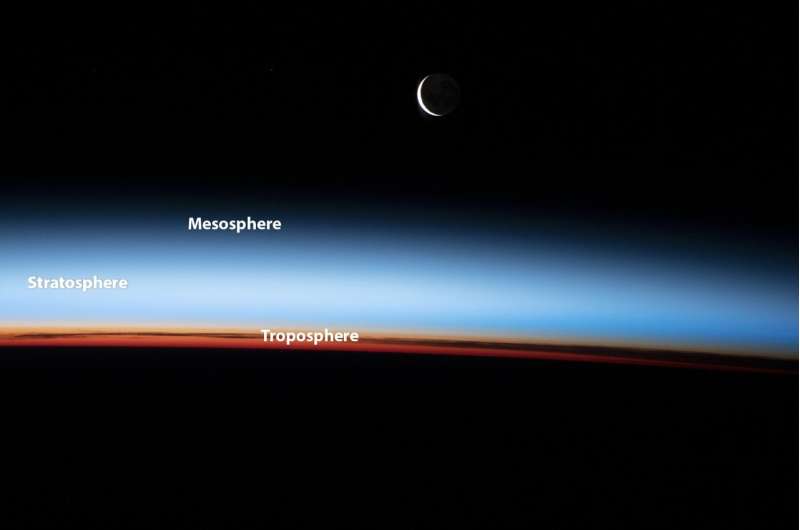
Kuala Lumpur, 12 May 2026 – A groundbreaking new study from Columbia University has solved a long-standing atmospheric puzzle: how rising carbon dioxide levels can dramatically cool the upper atmosphere (stratosphere) even as they warm the Earth’s surface and lower atmosphere.
The research, published in the journal Nature Geoscience, explains the physical mechanism behind this paradoxical phenomenon, which has become a clear “fingerprint” of human-caused climate change.

Key Findings
While surface temperatures and the troposphere continue to warm, the stratosphere (the layer between 11 km and 50 km above the surface) has cooled significantly. Since the mid-1980s, stratospheric temperatures have dropped by approximately 2°C — more than 10 times greater than what would be expected without human influence.
Lead researcher Sean Cohen from the Lamont-Doherty Earth Observatory at Columbia Climate School said:
“This explains a phenomenon that has been known for decades but whose mechanism was not fully understood.”
The Physical Mechanism
The study reveals that CO₂’s effect depends on how its molecules interact with infrared longwave radiation:
- In the lower atmosphere (troposphere): CO₂ acts as a heat trap — absorbing heat from the Earth’s surface and preventing it from escaping to space.
- In the stratosphere: CO₂ behaves like a radiator — efficiently absorbing infrared energy from below and radiating it directly out to space. The more CO₂ present, the more heat is lost to space, causing the layer to cool.
A crucial discovery: There is a “Goldilocks zone” at specific infrared wavelengths where CO₂ is most efficient at emitting heat. As CO₂ concentration increases, this zone expands, making the cooling effect even stronger.
The study also found that ozone and water vapor have far smaller influence on this cooling compared to CO₂.
Climate Implications
Although the stratosphere is cooling, this process actually strengthens surface warming. A cooler stratosphere emits less infrared energy outward, meaning more heat remains trapped in the Earth system.
Co-researcher Robert Pincus noted:
“We’ve understood this qualitatively for 50 years, but now we have a precise quantitative theory.”
Broader Impact
- Strengthens evidence that current climate change is driven by human activity.
- Improves accuracy of future climate models.
- Provides new insights into the atmospheres of other planets and exoplanets.
This research is expected to significantly influence global climate studies and satellite-based monitoring of the upper atmosphere.
Source: Columbia Climate School & Nature Geoscience (DOI: 10.1038/s41561-026-01965-8) Keywords: Carbon Dioxide, Stratospheric Cooling, Climate Change, Columbia University, Upper Atmosphere, Global Warming
Would you like a shorter version, Instagram caption, or any adjustments to the tone?