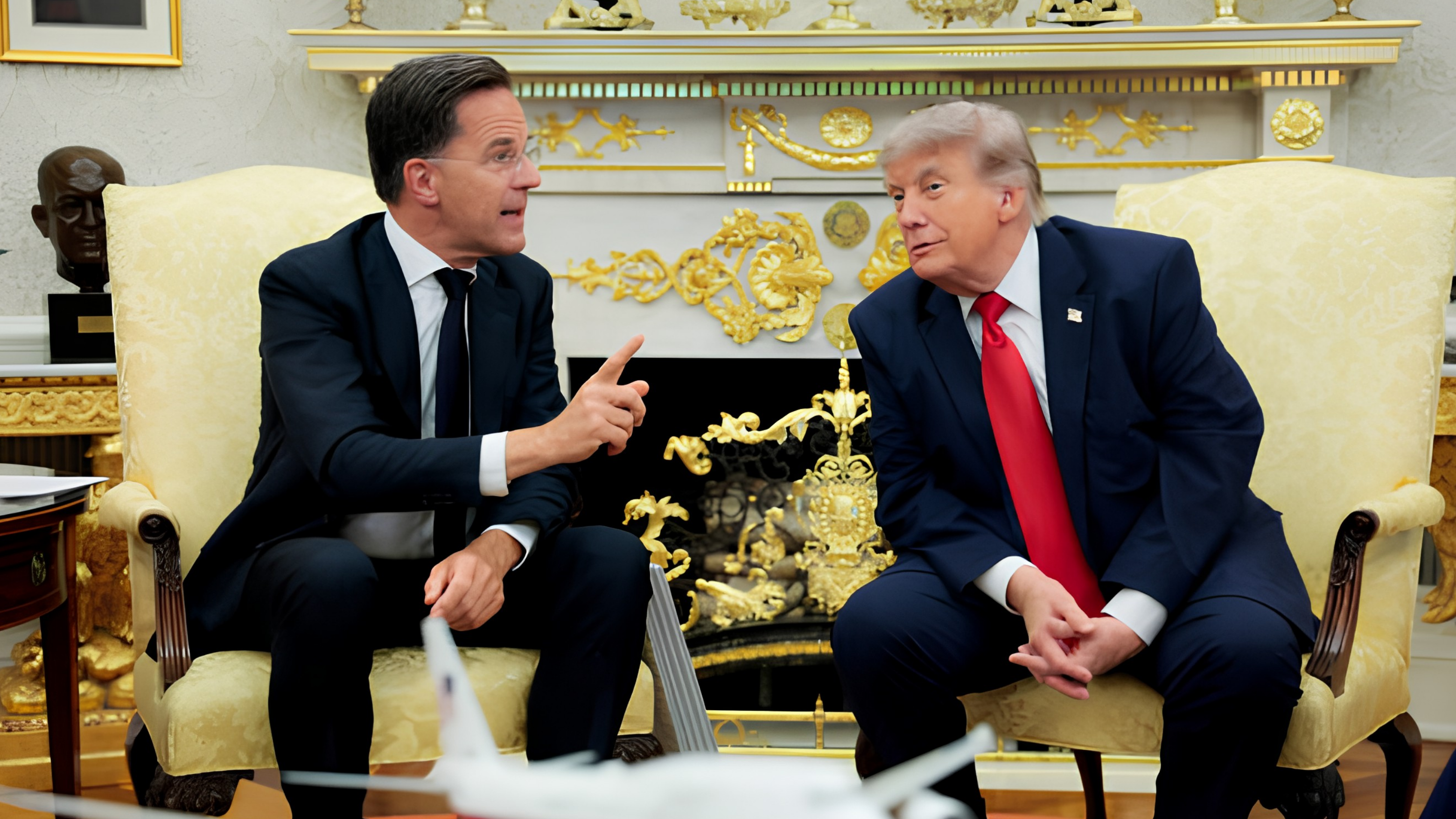
KUALA LUMPUR, June,2026 — NATO Secretary-General Mark Rutte met US President Donald Trump at the White House on Wednesday in a high-stakes effort to ease tensions inside the transatlantic alliance over the Iran war, European defence spending and Washington’s future military role in Europe.
The meeting came as NATO faces one of its most delicate political moments in years. Trump has been angered by what he views as limited European support for the US-led campaign involving Iran, while several allies have been cautious about direct involvement in the Middle East conflict.

Reuters reported that Rutte tried to calm the situation by combining personal praise for Trump with a diplomatic argument that European resistance to Washington’s Iran policy should not be seen as the position of the whole alliance.
During the Oval Office meeting, Rutte reportedly used charts to show how much NATO members had increased defence spending since Trump first entered office in 2017. The move appeared designed to appeal directly to Trump’s long-standing demand that allies contribute more to their own defence.
Rutte also told Trump that European allies had generally supported the United States, including by allowing thousands of US aircraft movements from bases in Europe during the Iran war. However, Trump appeared unconvinced and said the United States had been “let down” by some allies.
The Iran war has become a major source of tension between Washington and NATO. Trump has criticised allies that refused to support US military operations or help reopen the Strait of Hormuz, one of the world’s most important oil shipping routes, after the conflict disrupted global energy flows.
The issue also triggered a diplomatic dispute with Italy. Reuters reported that Rome pushed back against Rutte’s claim that hundreds of US aircraft had taken off from American bases in Italy to support operations against Iran, saying Italy had authorised only technical and logistical flights, not combat-related activity.
Italian Defence Minister Guido Crosetto said Rome had acted in line with its constitution, international treaties and agreements on allied bases, stressing that Italy had approved only “technical and logistical, non-kinetic activities.”
The dispute shows how sensitive the Iran conflict has become within NATO. While the alliance remains focused on collective defence in Europe, the US campaign in the Middle East has exposed differences among allies over military support, legal limits and political risk.
Rutte’s Washington visit also came before the NATO leaders’ summit in Ankara, scheduled for July 7–8. US Secretary of State Marco Rubio previously confirmed that Trump would attend the summit despite his frustrations with the alliance.
Rubio said Trump’s main irritation was that some NATO members had not allowed the US to use military bases in those countries “at a time of crisis.” He also described the upcoming summit as one of the most important meetings in NATO’s history because several disputes needed to be addressed directly.
Defence spending is expected to be one of the central issues. NATO’s own transcript from its June 18 defence ministers’ meeting shows that allies have expressed a strong commitment to reach 5% of GDP in defence spending by 2035, with European allies and Canada increasing defence investment by more than US$90 billion in real terms last year.
Rutte has been trying to frame these increases as proof that Europe and Canada are responding to Trump’s pressure. His message to Washington is that allies are stepping up, even if disagreements over Iran have created political strain.
At the same time, NATO is also facing pressure from changes in US military commitments to Europe. Reuters reported that the US has decided to reduce the pool of military capabilities committed to NATO in a crisis, including fighter jets, drones, refuelling aircraft, warships and bombers.
The planned reductions have raised concern among European allies, especially because they come while Trump has repeatedly questioned whether the US should continue to carry the main burden of European security.
Rutte has said other NATO members are already filling many of the gaps left by US cuts, although he also acknowledged that some areas still require more work.
The current tension reflects a broader debate over NATO’s future direction. Washington wants Europe to take more responsibility for its own defence, while European countries want to maintain a strong US security guarantee, especially as the war in Ukraine and wider security threats remain major concerns.
Trump has long argued that NATO allies rely too heavily on US military power. His criticism intensified after several European leaders avoided direct involvement in the US-Israeli campaign against Iran, partly because of legal, political and public opinion concerns at home.
For Rutte, the challenge is to keep Trump engaged with NATO while also protecting alliance unity. His approach appears to be based on acknowledging Trump’s influence over defence spending increases while trying to prevent disputes over Iran from turning into a deeper break between the US and Europe.
The strategy is risky. Too much praise could be seen as political flattery, while too much pushback could anger Trump at a sensitive moment. Rutte’s goal is to keep the alliance stable before the Ankara summit.
The meeting also matters because NATO’s Article 5 mutual defence commitment depends heavily on confidence in US leadership. Any suggestion that Washington might reduce its role in Europe or weaken its security guarantee can create anxiety across the alliance.
For European allies, the Ankara summit will likely be a test of whether increased defence spending can satisfy Trump and reduce the risk of further US drawdowns. For the United States, the summit will be a chance to demand more burden-sharing and clearer support during international crises.
The Iran issue adds another layer of complexity. NATO is not formally a party to the Iran war, but US expectations of allied support have turned the conflict into an alliance management problem.
If Rutte can convince Trump that NATO members are increasing spending and providing enough strategic support, the summit may help stabilise relations. If not, the alliance could face further uncertainty over US troop levels, defence planning and future crisis coordination.
Rutte’s meeting with Trump was not just a diplomatic visit. It was a serious attempt to prevent the Iran war dispute from widening into a larger NATO crisis.
The development is suitable for Update News because it involves current NATO-US tensions, Trump’s criticism of allies, Rutte’s White House diplomacy, Iran war strains, defence spending commitments and the upcoming NATO summit in Ankara.