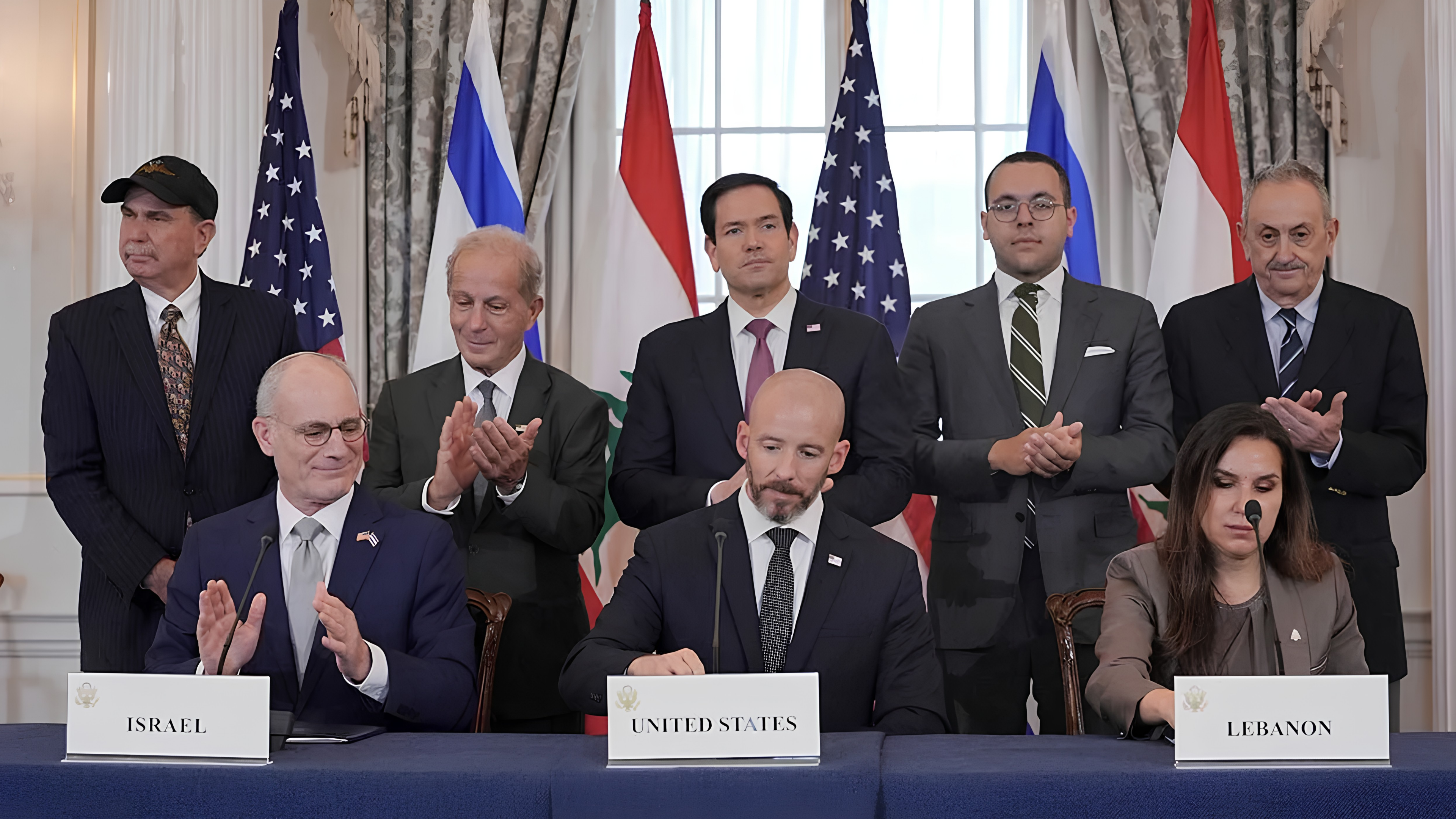
KUALA LUMPUR, June 2026 — Israel and Lebanon have signed a US-mediated framework agreement following talks in Washington, in what officials described as an initial step toward ending hostilities and supporting long-term security along the Israel-Lebanon border.
The agreement was announced by the United States after several days of mediated negotiations involving Israeli, Lebanese and US officials. According to Reuters, the document was signed at the US State Department by Lebanese Ambassador Nada Moawad, Israeli Ambassador Yechiel Leiter and US officials.

US Secretary of State Marco Rubio said the agreement represents a first step toward a difficult but necessary process. He said Washington would help facilitate implementation through a trilateral Military Coordination Group for Lebanon.
Astro Awani reported that Rubio said the framework includes the implementation of a ceasefire, on the condition that Hezbollah stops all attacks and withdraws from southern Lebanon.
The agreement comes after months of fighting between Israel and Hezbollah, the Iran-backed armed group based in Lebanon. Reuters reported that the latest round of hostilities began after Hezbollah fired at Israel on March 2, following US and Israeli attacks on Iran.
The conflict has caused severe damage inside Lebanon. Reuters reported that Israeli air and ground attacks have killed more than 4,000 people in Lebanon and displaced more than one million.
Lebanese Prime Minister Nawaf Salam said the framework agreement is intended to ensure Israel’s withdrawal from all Lebanese territory and restore Lebanon’s sovereignty over affected areas.
In a statement on X, Salam said Lebanon must strengthen state authority through its armed forces across all national territory. He also said the Lebanese state alone has the authority to decide matters of war and peace, in line with the mandate given by Parliament.
Salam thanked the United States, Arab countries and international partners who helped make the negotiations possible. He also expressed hope that the Israeli withdrawal process would begin immediately so displaced Lebanese citizens could return safely to their homes.
The agreement is viewed as an important diplomatic development because Israel and Lebanon do not have formal diplomatic relations. The framework does not represent a final peace treaty, but it creates a structure for further steps involving ceasefire enforcement, security coordination and possible Israeli withdrawal from occupied areas.
Reuters reported that Israeli Prime Minister Benjamin Netanyahu said the agreement allows Israeli forces to remain in southern Lebanon if Hezbollah does not disarm.
Netanyahu also said the agreement would allow the Lebanese army to begin organising control over certain areas, starting with two “pilot zones” from which Israeli troops would withdraw.
The “pilot zones” are expected to become a key test of the agreement. Under the concept, Lebanese forces would take control of selected areas, while non-state armed groups would be removed from those zones.
The United States has framed the process as a way to restore Lebanese sovereignty and reduce the threat of renewed cross-border conflict. Rubio said Washington would commit immediate humanitarian support, including US$100 million in aid coordinated with the United Nations.
Reuters also reported that the US intends to provide more than US$30 million under existing authorities and appropriations to improve the capabilities of the Lebanese Armed Forces.
The strengthening of the Lebanese army is central to the agreement. Washington and Beirut see the Lebanese Armed Forces as the institution that should eventually control southern Lebanon and prevent armed groups from operating independently.
However, the agreement faces serious challenges. Hezbollah remains a powerful military and political force in Lebanon, and Reuters reported that Hezbollah lawmaker Hassan Fadlallah said Lebanese authorities would not be able to enforce the agreement unless they moved toward civil war with US support.
Fadlallah also said Hezbollah would oppose measures taken by Lebanese authorities and would hold on to its weapons. This position shows that implementation may be difficult even after the signing of the framework agreement.
The deal also remains sensitive because both Israel and Lebanon have different expectations. Lebanon wants a clear timetable for Israeli withdrawal, while Israel wants security guarantees and Hezbollah’s disarmament before reducing its military presence.
Before the framework was signed, Reuters reported that Lebanon and Israel had begun a new round of talks on June 23 in Washington, with Beirut seeking progress despite the talks being overshadowed by the US-Iran deal.
Lebanese officials said direct negotiations with Israel were the only way to secure an end to the war, while President Joseph Aoun said Lebanon would accept nothing less than the complete end of Israeli occupation in southern Lebanon.
The withdrawal issue became more complicated after a US official said Israel had pulled back from part of its buffer zone, a claim later denied by both Israeli and Lebanese officials. Reuters reported that Israeli officials said there had been no pullback and that any redeployment would only happen after southern Lebanon was demilitarised and Hezbollah disarmed.
Israel has described the occupied area in southern Lebanon as a security or buffer zone designed to protect northern Israeli communities from Hezbollah attacks. Reuters reported that Israel has established a buffer zone about 10 kilometres into Lebanon from the Israeli border.
Lebanese officials, however, view the continued Israeli military presence as occupation and argue that full sovereignty cannot be restored until Israeli forces withdraw from Lebanese territory.
The agreement also comes amid continuing violence despite ceasefire efforts. Reuters reported that Israel said its troops had struck and killed seven Hezbollah members operating near the territory it occupies, although Reuters could not independently confirm the claim.
Israeli forces also dropped leaflets over the southern Lebanese town of Mansouri, warning civilians to leave the area. Lebanese state media said it was the first such order since the latest ceasefire took effect.
This shows that the agreement has not immediately ended tensions on the ground. While the diplomatic track has advanced, military risks remain high in southern Lebanon.
The framework is therefore best understood as a starting point, not a final settlement. It creates a process for ceasefire implementation, Lebanese army deployment, humanitarian aid and future Israeli withdrawals, but its success depends on whether all sides comply.
For Lebanon, the agreement offers a possible path toward restoring state control over the south and enabling displaced families to return. It also strengthens the position of the Lebanese government in asserting that decisions of war and peace must belong only to the state.
For Israel, the agreement offers a mechanism to reduce threats from Hezbollah while maintaining security demands before withdrawing from sensitive areas.
For the United States, the signing represents a diplomatic achievement in a region still affected by the wider US-Iran conflict, Hezbollah’s role in Lebanon and Israel’s security concerns.
The agreement also has broader regional implications. If implemented successfully, it could reduce one of the most volatile fronts in the Middle East and create space for reconstruction in areas damaged by months of war.
However, if Hezbollah refuses to disarm, if Israel maintains its military presence, or if ceasefire violations continue, the framework could face serious pressure before it produces concrete results.
the Israel-Lebanon framework agreement marks a significant diplomatic development after months of conflict. It opens a path toward ceasefire enforcement, possible Israeli withdrawal, stronger Lebanese state authority and humanitarian support, but its success will depend on difficult implementation on the ground.
The development is suitable for Update News because it involves a current Middle East diplomatic agreement, US-mediated talks, Israel-Lebanon security negotiations, Hezbollah conditions, ceasefire implementation and regional stability.