KUALA LUMPUR, JULY 2026 – China is planning a mission that could deliberately strike near-Earth asteroid 2015 XF261 as early as 2029 or 2030, in an effort to test technology designed to protect Earth from potentially dangerous space objects.
The proposed mission, being developed as part of the country’s expanding planetary defence programme, would attempt to slightly alter the asteroid’s trajectory by crashing a spacecraft into it at high speed. The target is estimated to be around 30 metres wide, although scientific estimates place its possible diameter within a broader range of approximately 16 to 69 metres.

The spacecraft could strike 2015 XF261 at approximately 32,444 kilometres per hour. The planned impact speed would be higher than that of NASA’s Double Asteroid Redirection Test, or DART, which collided with the asteroid moonlet Dimorphos in 2022 at about 22,016 kilometres per hour.
DART became the first full-scale planetary defence experiment to demonstrate that a spacecraft collision could measurably alter an asteroid’s orbit. China’s proposed mission is expected to build on that achievement while collecting more detailed observations before, during and after the impact.
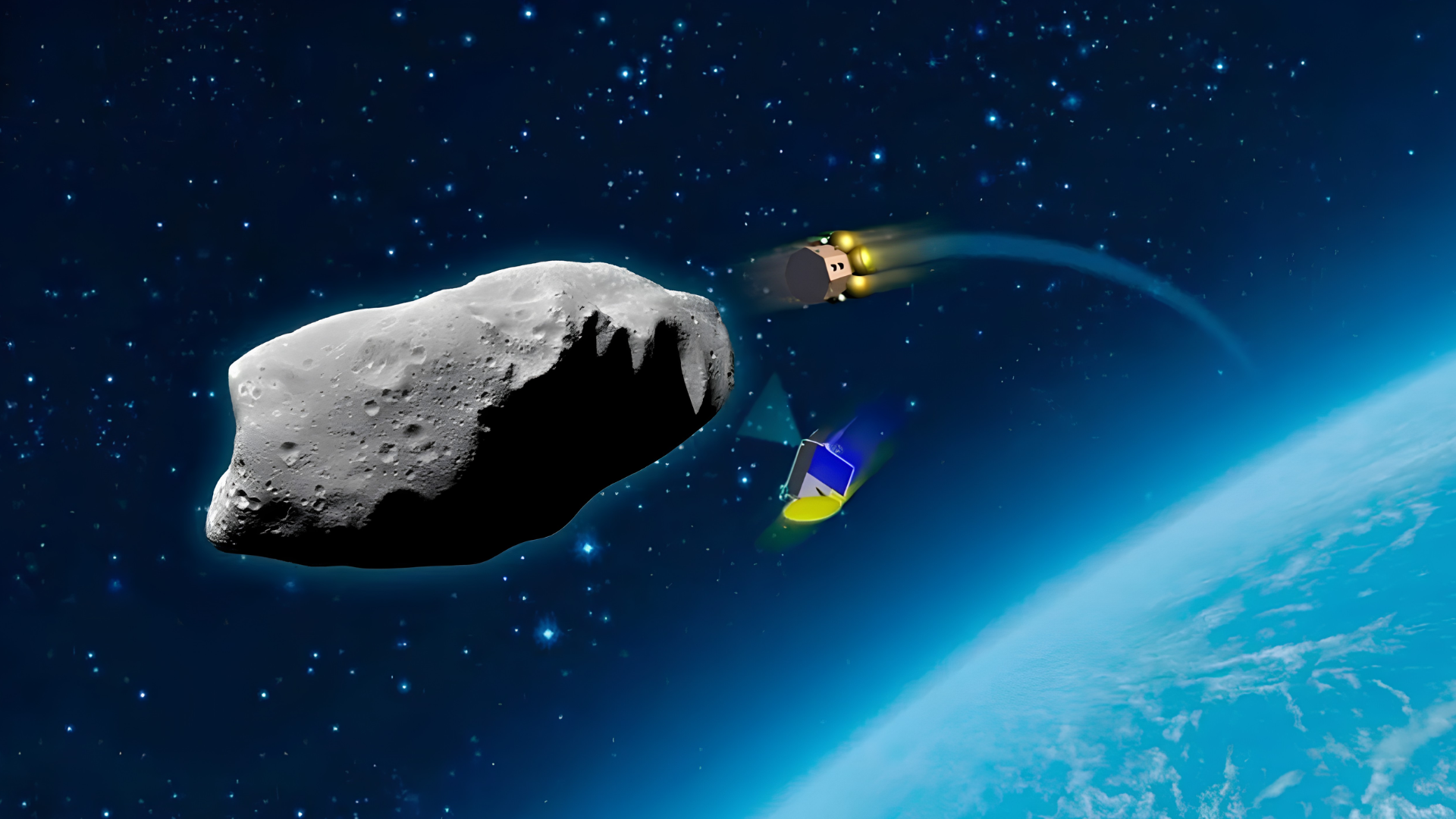
Preliminary mission designs involve launching two spacecraft on a single rocket. An observer spacecraft would travel to the asteroid first and conduct close-range studies, while a separate impactor would follow another trajectory before colliding with the object at high velocity.
The observer could examine the asteroid for between three and six months before the collision, collecting information about its dimensions, shape, composition, surface and orbit. It would then remain near the target for another six to 12 months to measure how the impact affected the asteroid and its surrounding environment.
Proposed scientific instruments include high-resolution colour cameras, a spectrometer, laser equipment, radar and particle analysers. The equipment would help researchers study the asteroid’s surface and internal structure, select an appropriate impact location and analyse the dust and debris released by the collision.
Scientific studies describe 2015 XF261 as an Aten-class near-Earth asteroid with an orbital period of approximately 359.7 days. Potential mission opportunities could occur when the asteroid approaches Earth in April 2029 and April 2030, passing at a distance of about seven million kilometres.
The object has been selected as a possible experimental target because its relatively small size could make any change in velocity easier to measure. However, 2015 XF261 is being considered for a controlled technology demonstration and has not been identified as an asteroid that is currently expected to collide with Earth.
One of the principal scientific challenges will be determining how the asteroid reacts to a powerful collision. Depending on its composition and internal structure, the impact could alter its orbit as intended, eject a large amount of material or potentially fragment part of the object.
Researchers would therefore need detailed pre-impact observations to calculate the asteroid’s original orbit and compare it with its trajectory following the collision. The results could improve understanding of how different types of asteroids respond to kinetic-impact techniques.
China is also developing a broader ground-and-space early-warning network for near-Earth objects. The proposed system could combine large optical telescopes, radar facilities and satellites positioned in several possible orbits to improve the detection of asteroids, particularly those approaching from the direction of the Sun.
More than 40,000 near-Earth asteroids have been discovered, but many smaller objects capable of causing significant regional or local damage remain undetected. Scientists say improved observation systems, international data sharing and tested deflection methods will be essential to strengthening global preparedness.
The proposed 2015 XF261 mission remains under development, meaning the final target, launch schedule and mission design could still change. Nevertheless, a successful test would provide another major set of real-world data on kinetic asteroid deflection and strengthen international efforts to manage future impact risks.