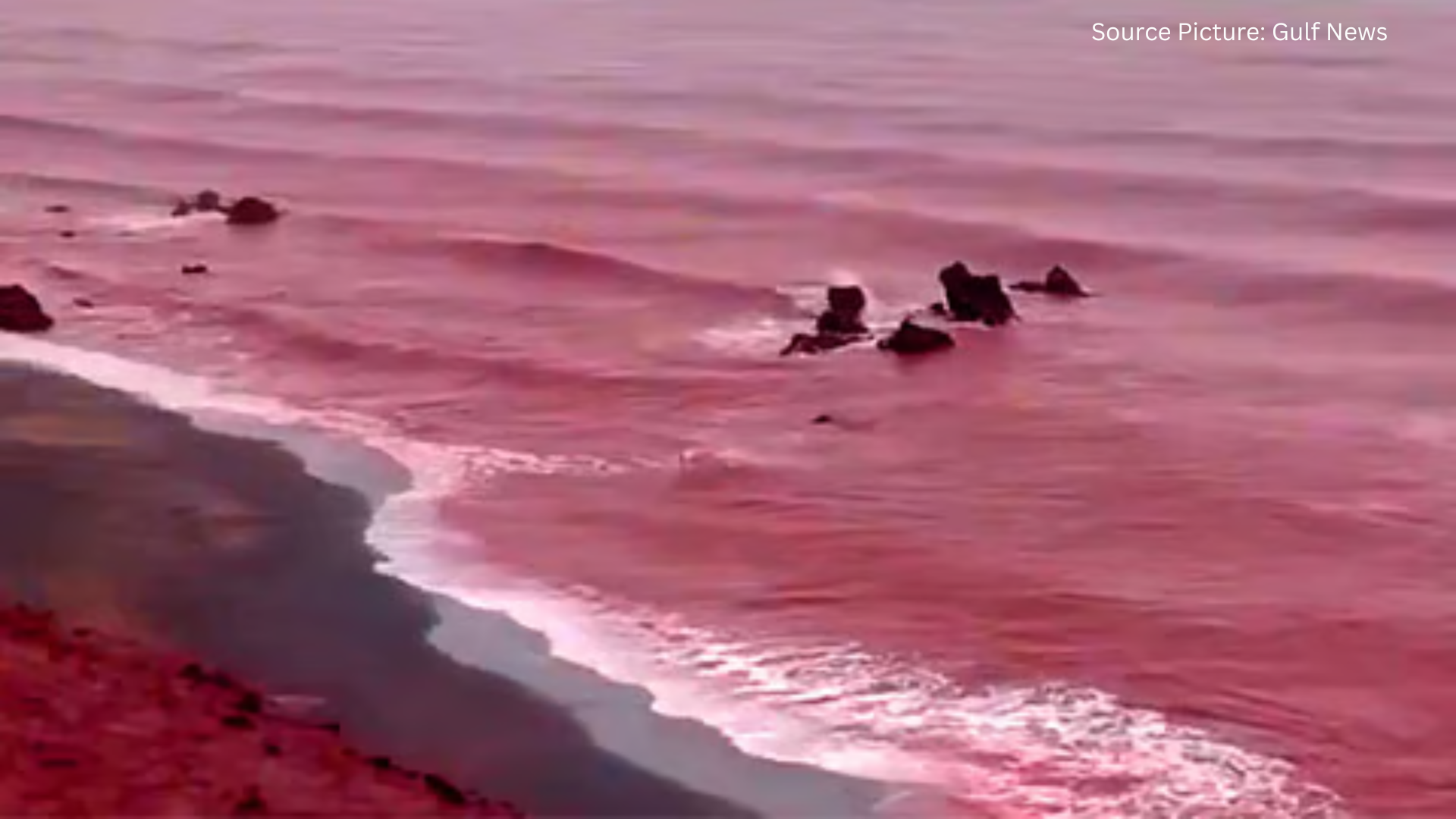
HORMUZ ISLAND, El Sky News – The world’s attention has turned to the Persian Gulf this week as a breathtaking natural phenomenon transformed the coastline of Hormuz Island into a vivid, blood-red landscape. Following a period of unusually heavy rainfall on Tuesday, December 16, 2025, the island’s famous “Red Beach” saw its turquoise waters replaced by deep shades of crimson, a sight that has since gone viral across global social media platforms.
While the dramatic visuals—often dubbed “blood rain” by online spectators—may appear otherworldly, scientists and geologists confirm that the event is entirely natural. The phenomenon is driven by the island’s unique mineralogy, particularly its high concentration of iron oxide, or hematite.

Hormuz Island, frequently called the “Rainbow Island” due to its kaleidoscopic soil, sits atop ancient salt domes and volcanic deposits rich in minerals. When torrential rains hit the island’s arid terrain, the runoff dissolves and mobilizes fine particles of red ocher. As this mineral-laden water flows through erosion channels and into the sea, it stains the sand and shallow seawater in intense shades of rust and ruby.
“This is nature’s chemistry in action,” explained a geological researcher. “The iron oxide on Hormuz is the same mineral responsible for the reddish hue of Mars. When it comes into contact with moisture, its color intensifies, and the resulting runoff creates a striking contrast against the deep blue of the Persian Gulf.”
Beyond the Spectacle: Culture and Science
- A Culinary Mineral: The red soil, known locally as Golak, is more than just a visual marvel. It is a vital part of the island’s culture, used as a traditional pigment in art and even as a spice in local delicacies such as ‘Surakh’ sauce.
- Environmental Safety: Authorities and environmental specialists have assured the public that the red coloration is non-toxic and poses no threat to human health or the local marine ecosystem. Unlike “red tides” caused by harmful algal blooms, this mineral runoff is temporary and harmless.
- Tourism Surge: The rare intensity of the color following this week’s storms has drawn a surge of photographers and nature enthusiasts, eager to witness the island’s transformation before the minerals settle and the tides return the water to its original blue.
As the weather stabilizes, the “crimson tide” is expected to dissipate within the next 48 to 72 hours. However, the event serves as a powerful reminder of how geology and weather can converge to create some of the most extraordinary landscapes on Earth.
(Leakim Otid)