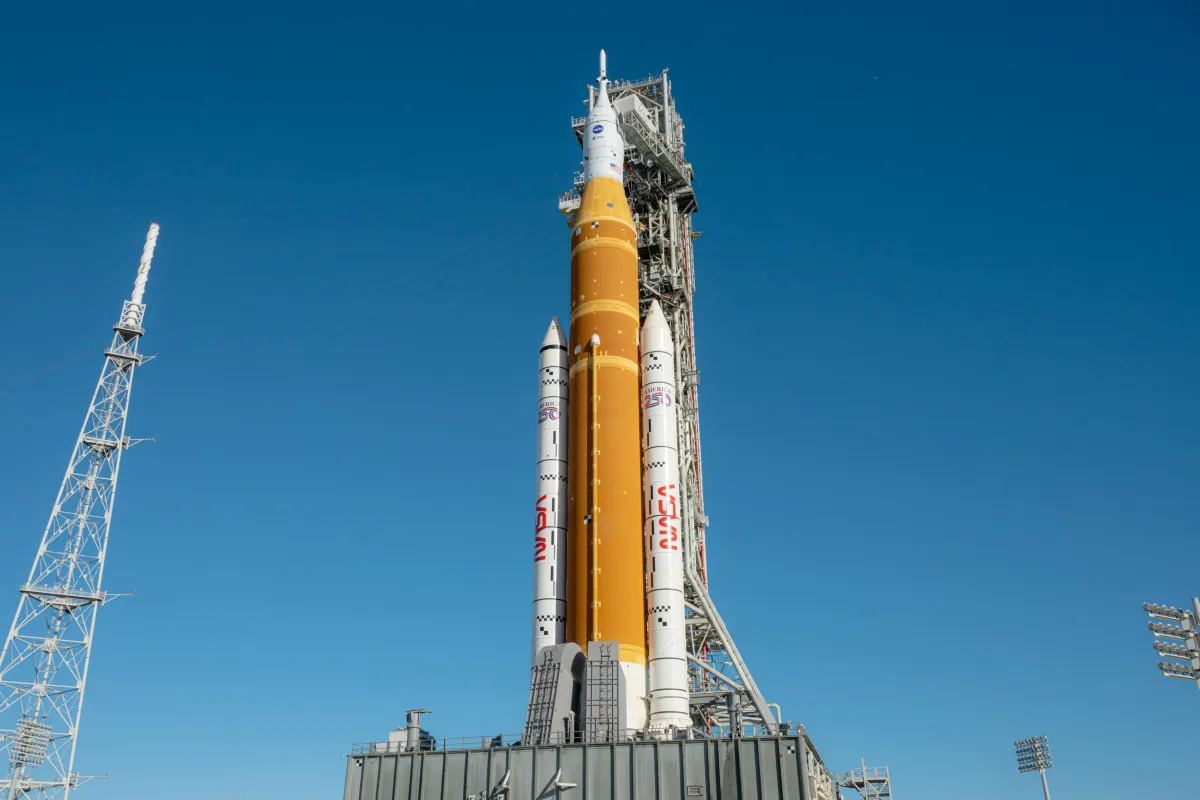
The historic Artemis II mission represents a major milestone in modern space exploration as it sends astronauts beyond Earth’s orbit toward the Moon for the first time since the era of Apollo program. The mission is part of NASA’s broader Artemis program, which aims to return humans to the Moon, establish a sustainable presence there, and eventually prepare astronauts for missions to Mars.
The mission launched from the Kennedy Space Center aboard the powerful Space Launch System rocket. Standing nearly 100 meters tall, the rocket is currently the most powerful launch vehicle developed by NASA and is designed to carry astronauts and cargo far beyond low-Earth orbit.

At the top of the rocket sits the Orion spacecraft, a next-generation deep-space capsule designed to carry astronauts safely on long-distance missions. Orion includes advanced life-support systems, navigation technology, and communication systems that allow astronauts to operate far beyond Earth’s orbit.
The Astronaut Crew
The Artemis II mission carries four astronauts representing both the United States and Canada. The crew includes:
- Reid Wiseman – Mission Commander responsible for overall mission leadership.
- Victor Glover – Pilot responsible for spacecraft navigation and operations.
- Christina Koch – Mission Specialist assisting with experiments and spacecraft systems.
- Jeremy Hansen – Mission Specialist representing Canada.
The mission is historic for several reasons. Christina Koch is set to become the first woman to travel to the Moon, Victor Glover will be the first Black astronaut to orbit the Moon, and Jeremy Hansen will be the first Canadian astronaut to participate in a lunar mission.
Mission Journey and Flight Path
The mission is expected to last around ten days and follows a complex flight path designed to test deep-space travel capabilities.
After launch, the Orion spacecraft enters Earth orbit before firing its engines to begin a journey known as trans-lunar injection, sending the spacecraft toward the Moon. The spacecraft will then travel around the far side of the Moon before reaching a distance thousands of kilometers beyond it.
Rather than landing on the Moon, Artemis II will perform a lunar flyby using the Moon’s gravity to sling the spacecraft back toward Earth on a “free-return trajectory.” This path ensures the spacecraft can return safely even in the event of major system issues.
At the end of the mission, Orion will re-enter Earth’s atmosphere and splash down in the ocean, completing one of the most important crewed test flights in modern space exploration.
First Images of Earth from Deep Space
During the journey, the crew captured stunning photographs of Earth from deep space. The images show the planet appearing as a bright blue sphere surrounded by the vast darkness of space.
Taken from more than 160,000 kilometers away, the photographs highlight the fragile beauty of Earth as seen from beyond its orbit. The images quickly captured global attention and served as a powerful reminder of humanity’s place in the universe.
Scientific and Technical Objectives
The primary goal of Artemis II is not landing on the Moon but testing the technology and systems required for deep-space human exploration.
Key mission objectives include testing Orion’s life-support systems, verifying navigation and communication technology, evaluating astronaut operations in deep space, and ensuring the spacecraft’s safety systems perform as expected.
These tests are essential before NASA attempts the next step of the Artemis program—sending astronauts to land on the Moon again.
Preparing for Future Moon Landings
Artemis II is a critical step toward the next phase of lunar exploration. Future missions under the Artemis program are expected to include landing astronauts on the Moon, building a sustainable lunar presence, and developing infrastructure such as a lunar space station known as Gateway.
Ultimately, NASA hopes the Moon will serve as a testing ground for technologies that will allow humans to travel even farther—to Mars.
More than half a century after the Apollo missions, Artemis II signals the beginning of a new era in which humanity once again ventures beyond Earth’s orbit, pushing the boundaries of exploration and preparing for the next giant leap into deep space.